All-on-4 dental implants use four strategically placed implants to support a full arch of replacement teeth, while All-on-6 uses six implants for added stability and force distribution. Both options provide fixed, non-removable restorations that function like natural teeth. At Center for Dental Implants, we help patients understand which approach best fits their bone structure, lifestyle, and long term goals.
If you’re missing most or all of your teeth in one arch, you already know how dentures can limit your daily life. Adhesives fail at the wrong moment. Certain foods become off-limits. Speaking clearly takes extra effort. Full-arch implant solutions change that equation entirely.
What Are All-on-4 and All-on-6 Dental Implants?
These care options are designed for patients who want a permanent alternative to removable dentures. Rather than sitting on top of your gums, implant-supported restorations anchor directly into your jawbone. This creates stability that dentures simply cannot match.
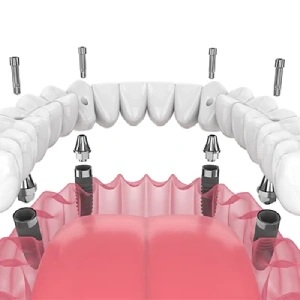
The All-on-4 approach positions four implants at precise angles to maximize contact with available bone. Two implants go in the front of the jaw, where bone is typically denser. Two additional implants are placed toward the back at an angle, which often eliminates the need for bone grafting.
All-on-6 follows the same principle but adds two more implants. This distributes chewing forces across six points instead of four, which can benefit patients with stronger bite patterns or those who want extra long term security.
Both options deliver a fixed prosthesis. You won’t remove it at night. You won’t soak it in a cup. Your new teeth stay in place while you eat, talk, and sleep.
How the All-on-4 and All-on-6 Procedures Work
The All-on-4 and All-on-6 care process involves a private consultation with 3D imaging, surgical implant placement, attachment of a temporary prosthesis within 72 hours, and a final restoration after three to six months of healing. Each step is thoughtfully planned with conservative planning to support predictable outcomes.
Your care begins with a thorough evaluation at Center for Dental Implants. We use 3D CBCT imaging to map your jawbone structure, identify nerve pathways, and plan exact implant positions before any surgery takes place. This digital planning phase is essential for predictable outcomes. Our implant specialists, led by Dr. Arun K. Garg, review every scan to ensure clinical precision, aesthetic judgment, and a care plan that fits your anatomy.
On surgery day, any remaining teeth that cannot be saved are extracted. The implants are then placed according to your custom care plan. Because the posterior implants are angled to engage denser bone areas, many patients qualify for immediate loading. This means a temporary prosthesis can be attached within 24 to 72 hours of surgery.
You leave with teeth that look and feel like your own. No gap to hide. No bulky healing denture to manage. Actual fixed teeth on the same day.
The temporary prosthesis functions well during the healing period, but it isn’t your final restoration. Over the next three to six months, your implants undergo osseointegration. Your bone grows around and fuses with the titanium implant surfaces, creating a foundation that can last decades.
Once integration is complete, we replace your temporary prosthesis with a permanent restoration. This final prosthesis is crafted in our in-house dental lab using CAD/CAM technology for precise fit and natural appearance.
Sedation options are available throughout the process. Whether you prefer oral sedation or IV sedation, our team monitors your vitals continuously and adjusts medication so you remain calm and comfortable from start to finish.
What Are the Benefits of Full-Arch Implant Solutions?
The difference between dentures and implant-supported teeth goes far beyond convenience. Dentures restore only a fraction of natural biting force. Full-arch implants restore the vast majority of that function, letting you eat foods you may have avoided for years.
Here’s what changes when you move from dentures to fixed implants:
- Bone preservation – Your jawbone needs stimulation to maintain its density. Dentures rest on top of your gums and provide no stimulation. Implants integrate with bone and help prevent the gradual bone loss that changes facial structure over time.
- No adhesives or slipping – Your teeth stay put. Period. No worrying about your prosthesis shifting during meals or conversations.
- Clearer speech – Loose dentures can affect pronunciation. Fixed restorations remove that variable.
- Better facial aesthetics – By preserving bone and supporting your lip and cheek structure, implants help maintain a more youthful facial profile.
- Long term durability – With proper care, implant-supported restorations can serve you for many years. The implants themselves often last a lifetime.
- Quality of life – Patients consistently report feeling more confident in social situations, more willing to smile, and more satisfied with their ability to eat the foods they enjoy.
All-on-4 vs All-on-6: Side-by-Side Comparison
The main difference is that All-on-4 uses four implants with angled placement to make the most of existing bone, while All-on-6 uses six implants for greater stability and force distribution across the arch. All-on-4 often suits patients with moderate bone loss, while All-on-6 fits those with adequate bone and stronger bite patterns. Both approaches, when delivered by our team led by Dr. Arun K. Garg, achieve excellent long term success.
Choosing between four and six implants depends on several factors specific to your situation. This comparison breaks down the key differences:
| Factor | All-on-4 | All-on-6 |
|---|---|---|
| Number of implants | 4 per arch | 6 per arch |
| Force distribution | Concentrated on 4 points | Spread across 6 points |
| Bone requirements | Works well with moderate bone loss | May require more bone density |
| Bone grafting | Often avoided due to angled placement | Sometimes needed for posterior implants |
| Cost | Generally lower | Higher due to additional implants |
| Surgical time | Typically shorter | Slightly longer procedure |
| Long term success | High | High |
When All-on-4 makes sense
You have moderate bone loss in the posterior jaw, want a cost-effective solution, and your bite forces are within normal range. The angled implant technique makes the most of your existing bone.
When All-on-6 makes sense
You have adequate bone throughout the arch, prefer additional support points, or have a stronger bite pattern. The extra implants provide redundancy and distribute forces more evenly.
Both approaches achieve excellent outcomes. The right choice depends on your anatomy, your goals, and what your evaluation reveals about your bone structure.
What Affects the Cost of Full-Arch Implants?
The cost of full-arch implant care is shaped by four main variables: the number of implants placed, the material chosen for the final prosthesis, whether preparatory procedures like bone grafting are needed, and the type of sedation used during surgery. Diagnostic imaging and custom lab work also factor in. Each element is discussed openly during your private consultation.
Full-arch implant care represents a significant investment in your oral health and quality of life. Several factors influence the total cost:
- Number of implants – Six implants cost more than four, both in hardware and surgical time.
- Prosthesis material – Options range from acrylic to zirconia to porcelain-fused restorations. Zirconia offers exceptional durability and aesthetics but comes at a higher price point.
- Preparatory procedures – Some patients need bone grafting, sinus lifts, or extraction of remaining teeth before implant placement.
- Sedation type – IV sedation involves additional costs compared to oral sedation or local anesthesia alone.
- Diagnostic imaging – 3D CBCT scans and digital planning are essential for predictable outcomes.
- Lab work – Custom prosthetics require skilled fabrication. Our in-house lab gives us control over quality and turnaround time.
We offer a Yearly Dental Membership Plan at $365 per year for patients without insurance. During your private consultation, we discuss all costs upfront so you can make an informed decision without surprises.
Who Qualifies for All-on-4 or All-on-6?
These care options work best for specific patient profiles. You may be a strong candidate if you:
- Are missing most or all teeth in one or both arches
- Have teeth that are failing due to decay, fractures, or advanced gum disease
- Currently wear dentures but want a fixed, permanent solution
- Have sufficient bone density or are willing to undergo grafting if needed
- Are a non-smoker or committed to quitting during the healing period
- Have controlled systemic health conditions like diabetes or hypertension
Certain factors require additional consideration. Uncontrolled diabetes can impair healing. Heavy smoking significantly increases implant failure risk. Severe bone loss may require grafting procedures before implant placement.
Age alone is rarely a disqualifying factor. We’ve successfully cared for patients well into their 80s, including retirees who came in unable to chew comfortably and left able to enjoy meals with family again. What matters more is your overall health, your bone quality, and your commitment to proper care after surgery.
The only way to know for certain is through a thorough evaluation. Our 3D imaging reveals exactly what we’re working with and allows us to plan your care with precision. Each plan reflects conservative planning, so we recommend only what your anatomy and goals truly require.
Frequently Asked Questions
How long do All-on-4 and All-on-6 implants last?
The titanium implants themselves can last a lifetime with proper care. The prosthesis attached to those implants typically lasts 10 to 15 years before needing replacement, though this varies based on material choice and how well you maintain your oral hygiene. Regular checkups at Center for Dental Implants allow us to monitor both the implants and the restoration so small concerns are addressed early.
Is the procedure painful, and what is recovery like?
Most patients report less discomfort than expected. We use appropriate sedation during surgery, and you’ll receive detailed post-operative instructions along with medication to manage any discomfort. Swelling and bruising are normal for the first week. Many patients return to desk work within a few days, though strenuous activity should wait two to three weeks.
Can I eat normally with full-arch implants?
Yes, but not immediately. During the initial healing period, you’ll follow a soft food diet to protect the implants as they integrate with your bone. Once your permanent prosthesis is placed, you can eat most foods without restriction. Apples, steak, corn on the cob. These become options again.
How do I clean and maintain my implants?
Daily care involves brushing with a soft-bristle brush and using a water flosser or interdental brushes to clean around the implants. You’ll also need professional cleanings at regular intervals. We provide specific instructions based on your prosthesis design.
What is the success rate of these procedures?
Full-arch implant procedures have well-documented success when performed by experienced implant specialists. Studies consistently show high success rates over many years, particularly when patients are properly evaluated, the surgical plan is thoughtfully planned, and post-operative care is followed closely. Dr. Arun K. Garg, a former university of miami professor who has trained over 20,000 dentists worldwide, brings decades of clinical authority to every case at our practice. Success depends on proper patient selection, surgical technique, and post-operative care.
How soon can I return to work after surgery?
Most patients take three to five days off from work. If your job involves physical labor, you may need a week or more. You’ll have functional teeth during this time, so the recovery period is more about allowing your body to heal than about being without teeth. Our team checks in with you during this window to confirm healing is progressing as expected.
Full-arch implant care can restore what tooth loss has taken from you: the ability to eat confidently, speak clearly, and smile without hesitation. Whether All-on-4 or All-on-6 is right for you depends on factors we can only determine through a proper evaluation, one grounded in clinical precision, aesthetic judgment, and respect for your goals.
Our approach at Center for Dental Implants blends advanced surgical clinical authority with digital planning and in-house craftsmanship to deliver outcomes built for long term success. Every step is designed to give you clarity, confidence, and peace of mind from the first consult through your final restoration, reflecting our commitment to elevated implant care and accessible expertise without compromise.
If you’d like to learn more about which option fits your needs, you can request a private consultation to discuss your evaluation with our team.
If you are considering tooth replacement, our team offers expert dental implant treatment across South Florida, including Aventura, Hallandale Beach, and Pembroke Pines.