No, they are not the same thing, and the distinction matters more than most patients are told. Full-mouth reconstruction is a treatment plan — a custom, case-specific rebuild of everything that has broken down in your mouth, which may involve implants, crowns, grafting, bite correction, and your own remaining natural teeth in any combination. All-on-4 is a single protocol — one specific way of replacing a full arch of missing teeth using four implants, two of them tilted, supporting one fixed bridge. All-on-4 can be part of a full-mouth reconstruction. It is not a substitute for one. Which path your case needs depends on how much healthy tooth structure remains, how much bone you have, whether your bite and jaw joints are stable, and what caused the breakdown in the first place.
Why This Comparison Confuses So Many Patients
One of the most common questions patients ask during a consultation is some version of: “I’ve been quoted for All-on-4 at one place and full-mouth reconstruction at another — which one is right?”
It is a fair question, and the confusion is understandable. Both terms describe rebuilding an entire mouth. Both involve implants. Both are presented as comprehensive solutions. But they belong to different categories of thinking, and comparing them directly is a little like comparing a blueprint to a building technique.
A treatment plan answers the question what does this particular mouth need? A protocol answers the question how do we execute one specific part of that plan? When a practice offers only one protocol, the plan and the technique collapse into the same answer for every patient who walks in. When a practice starts with diagnosis, the plan comes first and the technique is selected to fit it.
What Is Full-Mouth Reconstruction, Exactly?
Full-mouth reconstruction is the coordinated rebuilding of the upper arch, the lower arch, or both, using whichever combination of procedures the case actually requires. It is defined by its scope and its sequencing, not by any single technique.
A reconstruction plan may include:
- Extractions — Removing teeth that cannot be predictably saved, timed so that grafting or implant placement can happen in the same visit where appropriate.
- Bone grafting — Rebuilding ridge height, width, or density where prior tooth loss has caused resorption.
- Sinus augmentation — Creating vertical bone in the upper back jaw where the sinus floor has dropped into the space a molar used to occupy.
- Implant placement — Anywhere from a few implants to a dozen or more, positioned according to where bone exists and where chewing forces need to be carried.
- Crowns and onlays on natural teeth — Restoring teeth that are structurally sound enough to keep, so they continue contributing to the bite.
- Occlusal correction — Re-establishing the vertical dimension and contact pattern of the bite, often the single most technically demanding part of the plan.
- Periodontal therapy — Stabilizing active gum disease before anything is built on top of it.
The defining feature is that the plan is written after diagnosis, not before. Two patients with the same number of missing teeth can receive very different reconstructions because the causes, the bone, and the bite differ.
What Is All-on-4, Exactly?
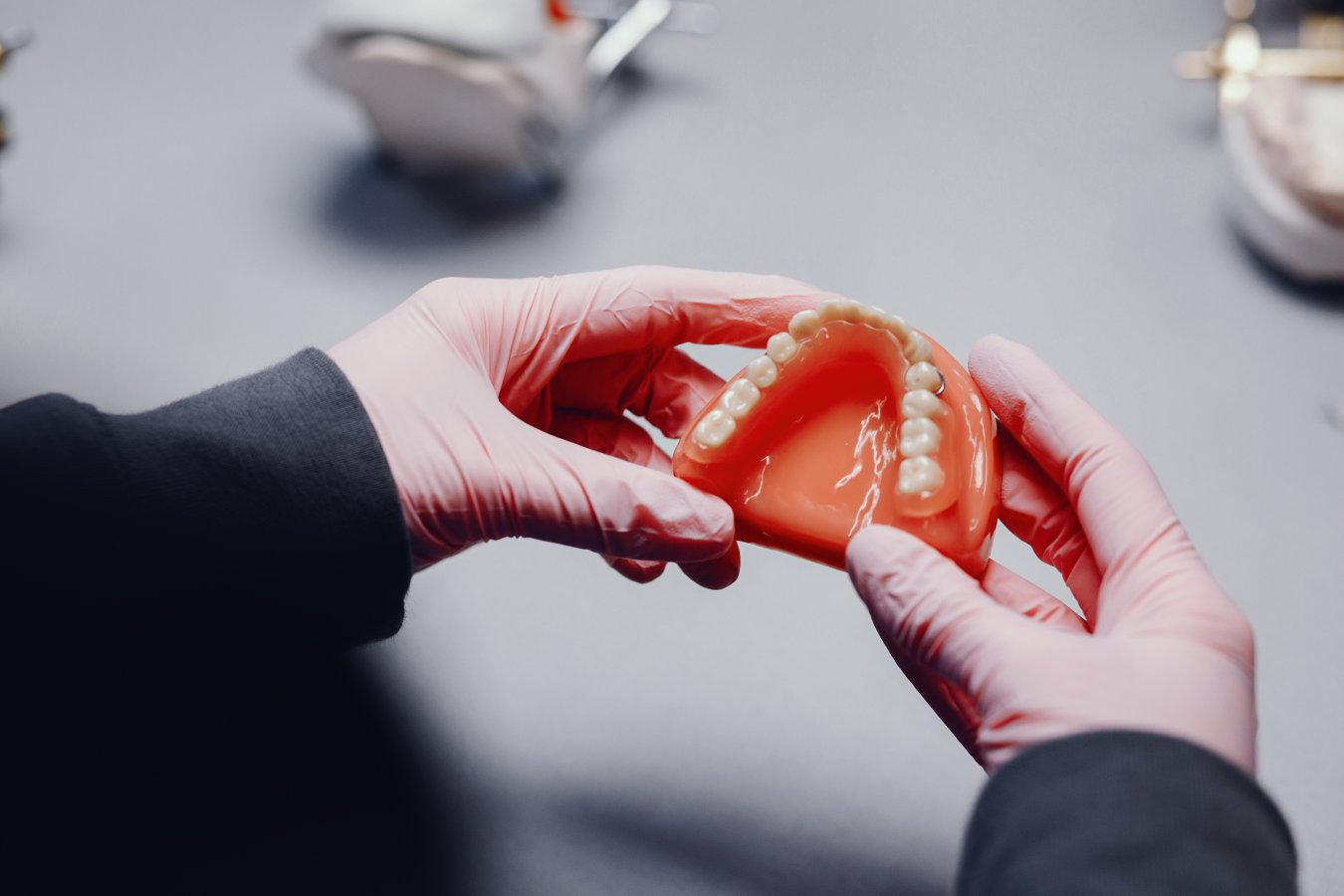
All-on-4 is a fixed full-arch implant protocol. Four implants are placed in one jaw. The two anterior implants are positioned vertically in the front of the jaw, where bone is typically densest and where the sinus and inferior alveolar nerve are not in the way. The two posterior implants are tilted — angled backward at roughly thirty to forty-five degrees — so that their emergence point sits further back in the arch without the implant body having to enter the sinus or approach the nerve canal.
That tilt is the entire engineering idea behind the protocol. By angling the back implants, the surgeon can support a bridge extending to the first molar region using only four fixtures, often in bone that would otherwise be considered inadequate. The four implants are splinted together by a single rigid framework, which distributes chewing load across all of them rather than letting any one implant carry a concentrated force.
All-on-4 is genuinely elegant, and for the right patient it is an excellent solution. It is also a solution to one specific problem: a fully edentulous arch, or an arch where every remaining tooth is failing, in a patient with enough bone in the anterior region to achieve stability at placement. Outside that scenario, the protocol is being asked to do work it was not designed for.
Implant Count: Why Four Sometimes Becomes Eight or Ten
Patients often assume that more implants simply means more expense and more surgery. In reality, implant count is a structural decision driven by bone, bite force, and arch shape.
Four implants work when the load is distributed by a rigid, well-fitting framework and the anterior bone is dense enough to hold each fixture immobile while it integrates. Additional implants become appropriate when:
- Bite forces are unusually high — Patients who clench or grind generate sustained loads that a four-implant framework may not tolerate as comfortably over decades.
- The arch is long or broad — A wide arch creates longer cantilever segments behind the last implant, and cantilever length is one of the most common contributors to framework fracture and screw loosening.
- Bone quality is soft — The upper jaw in particular often has less dense bone than the lower, and spreading load across six or more implants reduces the demand on any single one.
- The opposing arch is natural dentition — Chewing against your own healthy teeth generates more force than chewing against a denture, and the restored arch has to be built for it.
- Segmenting the restoration is preferable — With eight to ten implants, a surgeon can restore an arch in two or three separate sections rather than one long bridge, which makes future repair far simpler.
A full-mouth reconstruction may also use a mix: four or six implants supporting a fixed bridge in the upper arch, and individual implant crowns plus restored natural teeth in the lower. There is no rule that both arches must be treated the same way.
When Grafting or a Sinus Lift Has to Happen First
An implant needs bone around it in three dimensions. Where that bone is missing, it has to be rebuilt before — or in some cases at the same time as — placement. This is the step that most often separates a case that can be treated in one protocol from a case that needs a staged plan.
Advanced bone grafting becomes necessary when the ridge has resorbed in width or height to the point that an implant of adequate diameter and length cannot be seated within bone. This happens predictably after long-term tooth loss, after failed root canals or abscesses that destroyed localized bone, after trauma, and after years of wearing a removable denture that applied pressure to the ridge rather than stimulating it.
In the upper back jaw, the specific obstacle is usually the maxillary sinus. When upper molars are lost, the sinus floor tends to pneumatize downward into the space, leaving only a few millimeters of bone between the ridge crest and the sinus membrane. A sinus graft lifts that membrane and places graft material beneath it, generating the vertical height an implant requires.
Grafting adds time. Depending on the technique and the volume required, maturation can take several months before implants can be placed into the regenerated site — and in some cases implants can be placed simultaneously with the graft. That timeline is not a delay for its own sake. It is the difference between an implant anchored in bone and an implant anchored in hope.
Being told you need grafting before implants is not a rejection. It is a more complete answer than being told no.
Scope: What Reconstruction Addresses That a Full-Arch Protocol Does Not
Your bite and how the jaws meet
When teeth wear down, fracture, or are lost over many years, the vertical dimension of the bite — the height at which the jaws come together at rest and in function — often collapses. Patients notice it as a shortened lower face, deepening lines at the corners of the mouth, or a chin that appears to have moved forward. Rebuilding that dimension requires deliberate planning, provisional restorations to test the new position, and adjustment over time. A protocol focused on replacing a full arch of teeth does not by itself address how the two arches relate to each other.
Jaw joint and muscle considerations
Patients with a history of jaw joint discomfort, limited opening, clicking, or muscle soreness need that evaluated before the bite is rebuilt. Locking in a new bite position without understanding the joint can leave a patient with a beautiful restoration and persistent discomfort. Where these signs are present, an evaluation of joint function and muscle patterning belongs in the plan before definitive work begins. This is general education rather than a diagnosis of any individual case; joint symptoms require an in-person examination and imaging to interpret properly.
Keeping the teeth that are worth keeping
This is the difference patients feel most. A healthy natural tooth with intact root structure and sound periodontal support has a proprioceptive nerve supply that no implant reproduces — it is how you sense pressure and adjust your bite unconsciously. Full-mouth reconstruction preserves those teeth wherever the prognosis is good, restoring them with crowns or onlays and building the implant work around them. A full-arch protocol, by definition, requires removing everything in that arch. When several teeth are genuinely salvageable, that is a meaningful trade to weigh rather than assume.
Mixing crowns and implants in the same arch
A reconstruction commonly includes implant crowns in one region, a fixed implant bridge in another, and restored natural teeth in a third. Doing this well requires matching shade, contour, and wear characteristics across different materials so the result reads as one set of teeth. It is technically demanding work, and it is a large part of why in-house laboratory capability matters in complex cases.
Full-Mouth Reconstruction vs. All-on-4: Side by Side
| Factor | Full-Mouth Reconstruction | All-on-4 |
|---|---|---|
| What it is | A case-specific treatment plan | One fixed full-arch implant protocol |
| Implant count | Varies — from a few to 8, 10 or more, or none at all in some arches | Four per arch, two of them tilted |
| Natural teeth | Healthy teeth are kept and restored where prognosis allows | All teeth in the treated arch are removed |
| Bite and occlusion | Vertical dimension and contact pattern are deliberately re-established | Bite is set within the arch prosthesis; broader correction is a separate matter |
| Jaw joint factors | Evaluated and planned for as part of the sequence | Not inherently part of the protocol |
| Grafting | Included wherever bone volume requires it | Designed partly to reduce the need for it via tilted posterior implants |
| Typical timeline | Often several months to a year or more, in planned phases | Surgery in one day, with a final prosthesis after integration |
| Cost pattern | Varies widely; generally higher, since scope and component count are greater | Varies widely; typically a defined per-arch figure |
| Best suited to | Mixed damage, salvageable teeth, collapsed bite, complex histories | A fully failing or fully edentulous arch with adequate anterior bone |
How the Costs Compare
Any honest answer here has to start with a caveat: full-arch and full-mouth fees vary widely by region, by case complexity, and by what is included. A quoted figure that covers four implants and an acrylic provisional is not comparable to a figure that covers grafting, ten implants, a definitive milled prosthesis, and restoration of the opposing arch.
As a general pattern, a single-arch All-on-4 case typically carries a defined per-arch cost, because the component list is largely fixed: four implants, four abutments, one framework, one prosthesis. Full-mouth reconstruction typically costs more, and the range is far wider, because the component list is written per patient. Grafting, sinus augmentation, additional implants, individual crowns, provisional restorations, and sedation each add to the total.
Two things worth asking any practice, regardless of which path is proposed: what does the quoted number include, and what is the plan if the case turns out to need something the quote did not anticipate? Written scope beats a headline figure every time.
Recovery and Timeline Differences
All-on-4 concentrates the surgery into a single day. Extractions, implant placement, and delivery of a fixed provisional bridge happen in one appointment, followed by a soft-diet period of roughly three months while the implants integrate, then conversion to a definitive prosthesis. Swelling and bruising for the first several days are normal, and most patients describe the discomfort as manageable with prescribed medication.
Full-mouth reconstruction is phased. A typical sequence begins with disease control and extractions, moves to grafting where required, waits for graft maturation, places implants, waits again for integration, and finishes with provisional and then definitive restorations, with bite adjustment throughout. Each individual appointment tends to be less surgically intensive than an All-on-4 surgery day, but there are more of them, spread over a longer arc.
Patients often expect the longer path to feel harder. In practice, many find the opposite — the recovery is distributed rather than concentrated, and function is maintained along the way with provisional restorations.
How a Specialist Decides Which Path Your Case Needs
The decision is made from data, not from preference. A thorough evaluation includes CBCT 3D imaging to measure bone height, width, and density at each potential implant site; assessment of the periodontal status and prognosis of every remaining tooth; analysis of the existing bite and vertical dimension; review of medical history, medications, and systemic factors that influence healing; and digital treatment planning that models the final tooth position before any surgery is scheduled.
Only after that does the protocol get selected. Sometimes the answer genuinely is All-on-4, and it is the right answer. Sometimes it is six implants instead of four. Sometimes it is grafting first. Sometimes it is keeping seven natural teeth that another opinion had written off.
This is where the difference in approach becomes visible. A practice organized around a single protocol will naturally evaluate every case against the question can this patient have All-on-4? A practice organized around diagnosis asks a different question first: what does this mouth actually need, and which technique delivers it? Both can produce good outcomes for straightforward cases. The gap opens up in the complicated ones — and as we discuss in our overview of why not every implant case is simple, complexity is often not apparent from a photograph or a panoramic X-ray.
Dr. Arun K. Garg spent over 20 years as a full-time professor of surgery in the Division of Oral and Maxillofacial Surgery at the University of Miami Leonard M. Miller School of Medicine, where he also directed residency training. He is considered the world’s preeminent authority on bone biology, bone harvesting, and bone grafting for dental implant surgery, has published nine books translated into multiple languages, and has trained more than 20,000 dentists. In our practice, that background shapes how full-arch cases are evaluated: bone comes first, and the protocol follows from what the bone and the bite will support.
Frequently Asked Questions
Can All-on-4 be part of a full-mouth reconstruction?
Yes, and this is common. A patient may need a fixed four-implant bridge in the upper arch where all teeth are failing, while the lower arch is treated by keeping and restoring healthy natural teeth and placing individual implants in a few spaces. The reconstruction is the overall plan; All-on-4 is one component within it.
If I need bone grafting, does that rule out a fixed full-arch bridge?
Not usually. Grafting changes the sequence and the timeline rather than the destination. Once regenerated bone has matured, implants can typically be placed and a fixed bridge delivered as planned. What grafting does rule out, in most cases, is placing implants and loading them on the same day at that site.
How do I know whether my remaining teeth are worth saving?
It depends on root structure, remaining tooth substance above and below the gum line, periodontal bone support, and whether the tooth sits in a position that contributes usefully to the bite. This requires clinical examination and imaging — it cannot be judged from appearance alone. A second opinion is reasonable whenever an extraction plan feels broader than expected.
Is a longer treatment plan a sign of a more complicated case?
Often, yes — and that is worth knowing rather than avoiding. Staged plans usually reflect grafting, disease control, or bite rebuilding that has to happen in sequence for the result to hold. A timeline that accounts for those steps is generally a sign the case has been evaluated thoroughly.
Get a Plan Built Around Your Case, Not a Protocol
If you have been quoted for one approach and are not sure it fits what you are dealing with, a diagnostic evaluation with 3D imaging will tell you far more than a comparison of price sheets. You can schedule a complimentary implant consultation to review what your bone, your bite, and your remaining teeth will actually support.
Center for Dental Implants welcomes patients from across South Florida, with offices in Aventura, Hallandale Beach, and Pembroke Pines.