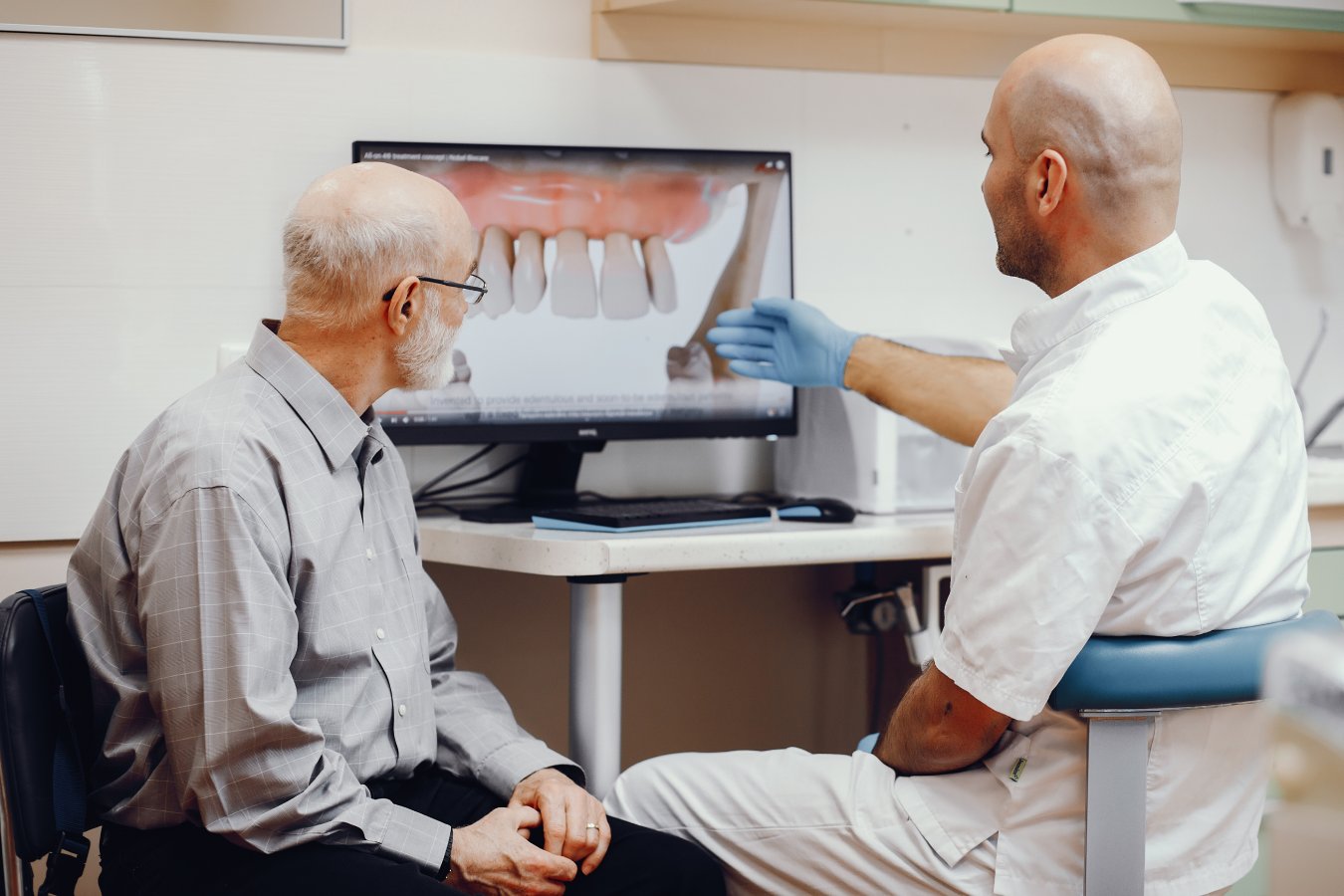
Here is the honest answer, before anything else: when you leave the office that day, you are wearing a fixed provisional bridge — a temporary set of teeth screwed onto your implants. It is not your final prosthesis. It looks like teeth, it functions well enough to speak and eat softly, and it is genuinely fixed in place rather than removable. But it is an interim restoration, usually made of acrylic, designed to be replaced by a definitive prosthesis after your implants have integrated with bone over roughly three to six months. “Teeth in a day” is a real and valuable protocol. It is also, as commonly advertised, an incomplete description of a process that takes considerably longer than a day to finish.
Why the Phrase Causes Disappointment
One of the most common questions patients ask after seeing an advertisement is some version of: “So I walk in with no teeth and walk out done?”
Not quite. You walk out with teeth. You do not walk out finished. The gap between those two statements is where most of the frustration in full-arch treatment lives — not because anything went wrong, but because the timeline was never fully explained at the start.
Patients who understand the phased structure going in tend to be satisfied with it. The provisional does a great deal of good: it restores appearance immediately, it lets you avoid the experience of being without teeth, it holds the soft tissue in the shape it needs to heal into, and it lets both you and your surgeon evaluate the tooth position, bite, and speech before anything permanent is made. Patients who expected to be done in a day tend to experience every subsequent appointment as a delay.
What Happens on the Day Itself
The day is long — commonly five to eight hours, sometimes split across a morning and afternoon session. Here is the usual sequence.
- Final review and imaging check. The surgical plan, built from CBCT 3D imaging and digital treatment planning, is confirmed against what is seen clinically. Guided surgery templates, where used, are verified for fit.
- Sedation or anesthesia. Depending on the case and your preference, this may be local anesthesia, IV sedation, or general anesthesia. This is discussed and arranged in advance, along with medical clearance where indicated.
- Extraction of remaining teeth. Any teeth in the arch that cannot be saved are removed, and the sockets are debrided. Damaged or infected tissue is cleared, since implants cannot be placed into an inflamed site.
- Ridge preparation. The bone crest is contoured to create a flat, predictable platform for the prosthesis and to establish enough vertical space for the restoration to be made strong enough.
- Implant placement. Four, six, or more implants are placed according to the plan. Each is torqued into position, and the insertion torque is measured — this number is central to what happens next.
- The stability decision. The surgeon evaluates whether each implant has achieved enough primary stability to be loaded immediately. This is a judgment made in the moment, with the implants in the bone.
- Abutment placement and impressions or scanning. Multi-unit abutments are attached, and the implant positions are recorded — increasingly with an intraoral scanner rather than conventional impression material.
- Provisional fabrication and delivery. The provisional bridge is fabricated or converted, tried in, adjusted for bite and contour, and screwed down. This is where an in-house laboratory shortens the day considerably.
- Post-operative instructions. Diet, hygiene, medications, warning signs, and the follow-up schedule are reviewed before you leave.
Immediate Loading: The Part That Decides Everything
This is the crux of the whole subject, and it is worth understanding properly.
An implant achieves stability in two phases. Primary stability is purely mechanical — it is the friction and interlock between the implant threads and the bone at the moment of placement. Secondary stability is biological — it develops over the following weeks and months as bone cells grow onto and into the implant surface, a process called osseointegration.
Between them there is a well-documented dip. Primary stability begins to decline as the bone immediately adjacent to the implant remodels, while secondary stability has not yet fully developed. The implant is at its most vulnerable during that transition.
Immediate loading works by using primary stability to carry the implant through that vulnerable window. If the initial mechanical grip is strong enough, and if the implants are splinted together by a rigid framework that distributes force across all of them, the implant can tolerate function while integration proceeds. If the initial grip is not strong enough, loading generates micromovement at the bone interface — and above a certain threshold of movement, the body responds by forming fibrous tissue rather than bone. That is implant failure.
So the decision is not about the patient’s schedule or preference. It is about a physical measurement taken during surgery.
What determines whether you have enough primary stability
- Bone density — Dense cortical bone grips an implant firmly. Soft, porous bone, common in the posterior upper jaw, grips less well.
- Bone volume — There must be enough height and width to place an implant long and wide enough to generate the necessary engagement.
- Insertion torque — The resistance measured as the implant is seated. Higher torque values generally indicate stronger primary stability, and most protocols set a minimum threshold below which immediate loading is not attempted.
- Implant design and site preparation — Thread geometry, implant length and diameter, and how the osteotomy was prepared all influence initial grip.
- Infection at the site — Active infection compromises the bone an implant needs to engage.
- The distribution of the implants — Splinted implants spread across the arch share load far better than implants clustered together.
A surgeon who places implants and then tells you the provisional will be delivered in a few weeks rather than today has not encountered a problem. They have measured something and responded to it honestly. That is the outcome you want.
The Osseointegration Window Nobody Advertises
Between the provisional and the definitive prosthesis is a period of roughly three to six months, and it has its own requirements.
During this time, bone is forming directly onto the implant surface. Excessive or uneven force can disrupt that process. So the provisional is deliberately built with a modified bite — often with reduced or eliminated contact in the back, and shortened cantilevers — specifically so it cannot be loaded as heavily as the definitive prosthesis will be.
The soft diet is real, and it is not a suggestion. Most protocols call for a genuinely soft diet for the first several weeks to a few months, progressing gradually. That means no crusty bread, no raw carrots, no steak, no ice, nothing that requires tearing or heavy grinding. Patients who ignore this are the ones who arrive at a follow-up with a fractured provisional or, less often, an implant that has failed to integrate.
There will be adjustment visits. Tissue shrinks as swelling resolves and the ridge remodels, which changes how the provisional sits. The bite settles and needs refining. Occasionally a provisional tooth chips and is repaired. These appointments are normal and expected, and they are rarely mentioned in advertising.
Hygiene starts immediately. Cleaning under a fixed provisional is the same skill you will need under the definitive prosthesis, and learning it during this period matters. Plaque accumulating against healing tissue is a genuine risk to integration.
Why the Final Prosthesis Is Made Later — and Usually Differently
There are three reasons the definitive restoration waits.
The tissue has to settle. After extractions and ridge preparation, gums and bone remodel for months. A definitive prosthesis made on day one would be fitted to contours that no longer exist by month four, leaving gaps at the tissue interface.
The implants have to prove themselves. Committing an expensive definitive prosthesis to implants that have not yet demonstrated integration is a poor sequence. The provisional period is, among other things, a test.
The provisional is a working prototype. Tooth position, lip support, midline, speech, and bite are all evaluated over months of real-world use. Anything that needs changing gets changed in acrylic — cheap, fast, easy — before it is committed to the final material.
The material almost always changes. Provisionals are made of acrylic because acrylic is easy to adjust and inexpensive to repair. Definitive prostheses are typically milled from monolithic zirconia or fabricated as a definitive acrylic hybrid on a titanium bar, chosen based on your bite force, esthetic priorities, and budget.
Immediate Load vs. a Staged Approach
| Factor | Immediate Load (“Teeth in a Day”) | Staged Approach |
|---|---|---|
| Teeth on surgery day | Fixed acrylic provisional | Usually a removable temporary, or healing period first |
| Requirement | Sufficient primary stability measured at placement | No stability threshold needed on day one |
| Grafting | Limited grafting only; extensive grafting generally rules it out | Allows full grafting and maturation first |
| Total timeline | Roughly 3–6 months to definitive prosthesis | Often 6–12 months or longer |
| Main advantage | Never without fixed teeth | Implants integrate without functional load |
| Main demand on you | Strict soft diet and adjustment visits | Patience, and a period with a removable temporary |
The Risks of Loading Too Early
Immediate loading is well established and, in appropriately selected cases, highly predictable. The risks come from applying it to cases that do not meet the criteria.
- Failed osseointegration — Micromovement beyond the tolerated threshold causes fibrous tissue to form at the bone interface instead of bone. The implant becomes mobile and must be removed.
- Loss of the site — A failed implant usually leaves a bone defect that requires grafting before another implant can be placed, adding months to the plan.
- Provisional fracture — An acrylic provisional loaded beyond its design capacity can break, which is inconvenient but also transmits shock to the implants.
- Compromised soft-tissue result — Movement at the tissue interface during healing can produce contours that are harder to work with when the definitive prosthesis is made.
None of this argues against the protocol. It argues for honest case selection, which is exactly the point.
When a Case Genuinely Cannot Be Immediate-Load
Some situations call for a staged approach from the outset, and some are only identified during surgery.
- Extensive grafting is required first — Where the ridge lacks the volume to place implants at all, bone grafting has to mature before placement. The graft, not the implant, sets the timeline.
- A sinus lift with substantial augmentation is needed — Regenerated bone in the upper posterior needs time to consolidate before it can hold an implant under load.
- Bone density is too low — Soft bone may allow placement without allowing immediate loading.
- Insertion torque falls short — Measured at surgery. This is the most common reason a plan changes on the day.
- Active infection is present — Which must resolve before implants are loaded.
- Medical or medication factors affect healing — Certain systemic conditions and medications influence bone metabolism and healing capacity. These require review and clearance from your physician; this article is general education and not medical advice.
- Heavy parafunction — Severe grinding may argue for protecting the implants from load during integration.
If you are told your case needs a staged approach, that is a good sign. It means someone measured rather than assumed. Complex cases are common, and as we explain in our discussion of why not every implant case is simple, the complexity is often invisible on a two-dimensional X-ray. Where the plan expands beyond one arch — bite correction, retained natural teeth, both jaws — it becomes a full-mouth reconstruction with its own sequence.
Dr. Arun K. Garg spent over 20 years as a full-time professor of surgery and director of residency training in the Division of Oral and Maxillofacial Surgery at the University of Miami Leonard M. Miller School of Medicine, and is considered the world’s preeminent authority on bone biology and bone grafting for dental implant surgery. In our practice, immediate implant placement and loading is offered when the bone supports it — and a staged plan is recommended, without apology, when it does not.
Frequently Asked Questions
Will my temporary teeth look like my final ones?
Close, but generally not identical. The provisional establishes tooth position, length, and lip support, and it is deliberately treated as a prototype you can evaluate over months. The definitive prosthesis is refined from what the provisional teaches, and it is made in a material with better translucency, shade stability, and surface finish.
Can I eat normally with the provisional?
No. A genuinely soft diet is required for the first several weeks, progressing gradually under your surgeon’s direction. The provisional is built with a reduced bite specifically so it cannot be loaded heavily. Most patients find this the hardest part of the process, and it is the part most closely linked to whether the implants integrate successfully.
Why do some practices say the final teeth come in a day?
Language around this varies. In nearly all full-arch cases, what is delivered on the surgery day is a provisional, and a definitive prosthesis follows after integration. If a practice describes a same-day final restoration, ask directly what material it is made from, whether it will be replaced later, and whether that replacement is included in the quoted fee.
What happens if one implant fails during healing?
It depends on how many were placed and where the failed one sits. With six implants, the remaining five can sometimes continue to support the provisional while the site heals and is regrafted. With four, losing one usually means the provisional must be removed or converted while the site is managed. Either way, a failed implant is generally replaceable after the bone is rebuilt.
Get a Straight Answer About Your Timeline
The most useful thing you can learn before committing to full-arch treatment is whether your bone will support immediate loading — and what the plan is if it does not. You can schedule a complimentary implant consultation to review 3D imaging and get a realistic sequence rather than a slogan.
Center for Dental Implants welcomes patients from across South Florida, with offices in Aventura, Hallandale Beach, and Pembroke Pines.