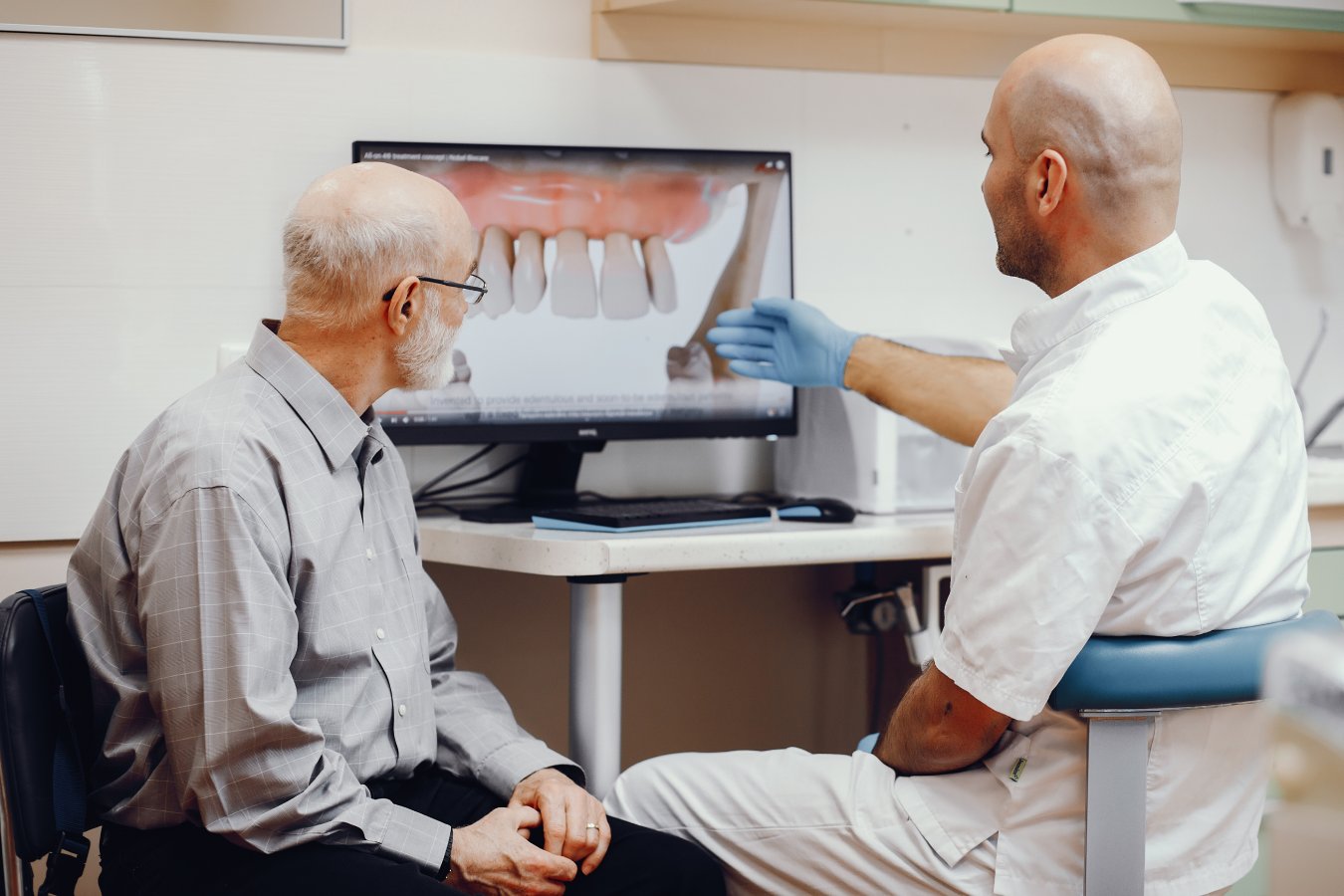
“Same-day implants” describes two different things that patients almost always hear as one. Immediate placement means the implant goes into the socket the same day the tooth comes out. Immediate loading means a temporary tooth is attached to that implant right away. A case can be one, both, or neither — and the criteria for each are different. Immediate placement generally requires intact socket walls, no active infection at the site, and enough bone beyond the tip of the socket to hold the implant firmly. Immediate loading adds a further requirement: the implant must achieve measurable stability at the moment of placement, and your bite has to be controllable enough not to overload it while it heals.
Immediate Placement and Immediate Loading Are Not the Same Thing
One of the most common questions we hear at a consultation is some version of: “Can I walk out of here with a tooth the same day?” It is a fair question, and answering it well means separating two decisions that happen hours apart in the same appointment.
Immediate placement is about the implant. Traditionally, a tooth is extracted, the socket heals for several months, and the implant is placed into healed bone. With immediate placement, the extraction and the implant happen in one sitting — the implant is seated into the fresh socket, engaging bone beyond and around it.
Immediate loading is about the tooth you can see. Traditionally, an implant is left undisturbed under the gum or with a healing cap for a period of months while bone grows into its surface. With immediate loading, a temporary crown or bridge is attached the same day, so you leave with something that looks like a tooth.
Those decisions are independent. It is entirely common to place an implant immediately and still wait months before loading it. It is also possible, in a fully healed site, to load an implant immediately even though the placement was not immediate. Understanding which one is being offered to you is the first step in evaluating any same-day proposal.
Immediate Placement vs Immediate Loading vs the Staged Approach
| Factor | Immediate Placement | Immediate Loading | Staged Approach |
|---|---|---|---|
| What happens | Implant placed the day the tooth is removed | Temporary tooth attached the day the implant is placed | Extract, heal, place, heal, restore |
| Main requirement | Intact socket walls, no active infection, bone beyond the socket | Sufficient primary stability measured at placement | Healed, adequate bone at each stage |
| Number of surgeries | Fewer — extraction and placement combined | No additional surgery; changes the restorative sequence | More appointments, often more procedures |
| Effect on total timeline | Removes several months of socket healing | You have a tooth immediately; final crown still waits for integration | Longest overall, in predictable segments |
| Effect on gum and bone shape | Helps preserve socket architecture | Provisional supports gum contour while healing | Ridge resorbs during healing unless grafted |
| Best suited to | Clean extractions with good surrounding bone | Dense bone, controlled bite, high stability readings | Infection, damaged sockets, grafting cases, higher risk profiles |
| Main trade-off | Less margin for error in positioning | Requires strict diet and bite discipline during healing | More total time and visits |
What Makes Someone a Candidate for Immediate Placement?
The implant needs somewhere to grip. A fresh extraction socket is a hole shaped like a root, and an implant is not shaped like a root — so stability has to come from the bone surrounding and beyond that socket. These are the conditions that make it work:
- Intact socket walls — The thin plates of bone on the cheek side and tongue side of the socket must still be present and continuous. If the tooth was lost to a fracture or advanced disease that destroyed the outer wall, there is nothing to contain a graft or protect the implant surface.
- No active infection at the site — Chronic inflammation at the root tip is often manageable with thorough debridement. Active, acute infection with pus and swelling is a different matter and usually means the site needs to settle first.
- Bone beyond the socket apex — The implant typically has to engage several millimeters of solid bone past the bottom of the socket, or against its walls, to be held firmly. In the lower jaw, that has to be balanced against the nerve canal. In the upper back jaw, against the sinus floor.
- Healthy surrounding gum tissue — Sufficient firm tissue to close or contain the site and to shape the eventual emergence of the crown.
- A restorable position — The implant must sit where a crown can actually be built on it, which in a fresh socket often means angling it toward the tongue side rather than following the socket’s natural path.
Immediate placement is frequently combined with grafting. The gap between the round implant and the wider socket is commonly filled with graft material to support the outer bone wall while everything heals — one of the reasons grafting technique is so closely tied to whether same-day placement is a sound choice in a particular case.
What Additionally Makes Someone a Candidate for Immediate Loading?
Attaching a tooth to a fresh implant means asking that implant to resist force during the exact period when bone is growing onto its surface. Small amounts of movement are tolerated. Too much movement disrupts integration. So the bar is higher.
- Sufficient primary stability, measured — Primary stability is the mechanical grip the implant has in bone at the moment it is placed, before any biological healing. It is assessed by the insertion torque recorded as the implant is seated and often confirmed with a resonance frequency reading. This is a number obtained during surgery, which is why immediate loading can be predicted beforehand but only confirmed on the day.
- Adequate bone density — Dense bone grips better. Soft bone in the upper back jaw is the classic site where stability falls short of what loading requires.
- A controllable bite — The provisional is usually designed so it barely contacts the opposing teeth, and does not take force when you slide your jaw sideways. Some bites make that impossible to arrange.
- No heavy bruxism — Grinding and clenching generate sustained lateral force well beyond normal chewing. Significant bruxism is one of the more common reasons to decline immediate loading even when everything else looks favorable.
- Willingness to follow a soft diet — For a period of weeks, the provisional is for appearance and gum shaping, not for chewing. Patients who cannot commit to that are not good candidates, and saying so plainly is part of a responsible plan.
In full-arch cases, the arithmetic shifts. Multiple implants splinted together by one provisional share the load, which is why immediate loading is sometimes feasible for a full arch even when it would not be for a single tooth in the same bone.
How Do General Health Factors Affect Candidacy?
Same-day protocols compress healing demands into a shorter window, so anything that slows healing carries more weight. This is general education, not medical advice, and none of it should be acted on without your physician.
- Diabetes — Well-controlled diabetes is compatible with implant treatment. Poorly controlled blood sugar impairs wound healing and raises infection risk, and immediate protocols leave less room for that. We coordinate with your physician on where your control currently stands.
- Smoking and vaping — Nicotine constricts small blood vessels and reduces blood flow to healing tissue. Smoking is consistently associated with higher implant failure rates and is a genuine consideration when weighing an immediate approach.
- Medications affecting bone — Bisphosphonates, certain other antiresorptive drugs, some biologic agents, high-dose corticosteroids, and prior head-and-neck radiation all change how bone responds to surgery. Never stop or alter a prescribed medication on your own. Any adjustment is a decision for the prescribing physician, made together with your surgical team.
- Immune status and healing history — Conditions or treatments that suppress immune function warrant a more conservative, staged plan in many cases.
The point of reviewing all of this is not to disqualify people. It is to decide whether the compressed timeline is a reasonable risk for your particular biology, and that decision belongs jointly to you, your surgeon, and your physician.
How Can Candidacy Be Predicted Before the Day?
Very largely, and this is what separates a considered same-day plan from a hopeful one.
A CBCT scan shows the socket walls, the thickness of the outer bone plate, the volume of bone available beyond the socket apex, the density of that bone, and the distance to the nerve canal or sinus floor. Digital planning software then lets the implant be positioned virtually to test whether a stable, restorable placement exists at all. If the plan cannot be made to work on screen, it will not work in the chair.
Guided surgery extends that further. When the implant position is planned in advance, a provisional crown can be designed and fabricated before the surgery date rather than improvised afterward — which is what makes a same-day tooth a prepared step instead of a scramble. The imaging and digital planning tools a practice uses are therefore not a marketing detail here; they are the mechanism by which candidacy is assessed honestly in advance.
What imaging cannot do is measure primary stability. That number exists only once the implant is in bone. So the responsible framing is: planning tells us whether you are likely a candidate, and the surgery itself confirms it.
What Happens If You Turn Out Not to Be a Candidate?
Sometimes the tooth comes out and the site is not what the imaging suggested — a socket wall is thinner than it appeared, there is more infection than expected, or the implant does not reach the torque required to support a temporary tooth. This happens, and it is worth knowing in advance what it means.
The response is to stage the case:
- The socket is grafted at the time of extraction to preserve ridge width and height instead of letting it collapse.
- Healing is allowed — typically a few months, depending on the graft and the site.
- New imaging is taken and the implant is planned into rebuilt bone.
- The implant is placed and given time to integrate before the final restoration.
- A temporary tooth — a removable partial or a bonded provisional — bridges the gap in the meantime, so you are not without a tooth in a visible space.
Choosing this path is not a failed surgery. It is a surgeon declining to place an implant in conditions that would put it at avoidable risk. An implant that integrates on the second attempt at month six is a far better outcome than one loaded prematurely that fails at month three and leaves a defect to reconstruct. When a plan changes mid-procedure for that reason, the change itself is the good clinical decision.
What Are the Real Benefits When It Does Work?
- Fewer surgical procedures — One appointment rather than two, one recovery rather than two, one course of anesthesia rather than two.
- Preserved socket architecture — Bone begins to resorb as soon as a tooth is gone. Placing an implant and graft into the fresh socket helps maintain the ridge contour and the shape of the gum around it, which matters most in the front of the mouth.
- Less total time — Removing several months of socket healing from the sequence can shorten the overall case considerably.
- Better gum contour — A well-designed provisional shapes the gum tissue as it heals, so the tissue is already the right shape when the final crown is made.
- You are not without a tooth — For a front tooth in particular, this is not a cosmetic footnote. It is often the difference between proceeding with treatment and postponing it.
Whether those benefits apply to you is a question that gets answered by imaging and examination, not by a general article. You can read more about how we approach immediate implant treatment and what the appointment involves.
Frequently Asked Questions
Will the tooth I leave with be my permanent tooth?
Almost never. A same-day restoration is a provisional — designed for appearance and for shaping gum tissue rather than for full chewing force. The final crown or bridge is made after the implant has integrated with bone, typically several months later, and is built to different standards of strength, fit, and material.
Are same-day implants less successful than staged implants?
When candidacy criteria are respected, published outcomes for immediate protocols are broadly comparable to staged treatment. The important qualifier is case selection. Immediate approaches used indiscriminately, in sites or patients that do not meet the criteria, carry higher risk. The protocol is not the variable that matters most; the judgment applied to it is.
Can I get same-day implants if I need bone grafting?
Sometimes. Minor grafting around an implant placed into a fresh socket is routine and does not rule out same-day placement. Significant reconstruction of a deficient ridge is different — that generally needs to heal before an implant can be placed, which makes the case a staged one by definition.
What if only some of my implants can be loaded immediately?
That is a common outcome in full-arch cases and it is workable. If several implants achieve strong stability and one does not, the provisional can often be designed to rest on the stable implants while the weaker one is left to heal undisturbed and brought into the restoration later. Your surgeon makes that call during surgery based on the readings taken.
Find Out Whether Same-Day Is Realistic for You
The useful conversation is not whether a practice offers same-day implants. It is whether your specific socket, your specific bone, and your specific bite make same-day a sound choice — and what the plan is if they do not. That takes a scan, an exam, and a candid discussion of both paths. Schedule a consultation and we will give you a straight answer either way.
Center for Dental Implants welcomes patients from across South Florida, with offices in Aventura, Hallandale Beach, and Pembroke Pines.