Yes — smoking measurably raises the risk that a dental implant will fail, with research commonly reporting failure rates in smokers roughly two to three times those seen in non-smokers. The mechanism is largely vascular: nicotine constricts the small blood vessels that supply the surgical site, heat and smoke compromise the healing soft-tissue seal, and immune response is blunted. That risk is highest at grafted sites and sinus augmentations, which depend entirely on new blood vessel ingrowth. Smokers are not refused implant treatment here. Planning adapts, the risk is discussed openly, and long-term maintenance is set accordingly.
A note on scope: this article is general education about long-term candidacy and failure risk, not medical advice, and it is not a post-operative instruction sheet. Specific guidance about your own healing period comes from your surgeon. If you are working on quitting, the medications and programs that support that are your physician’s territory, and nothing here should change how you take anything you have been prescribed.
One of the more candid questions patients ask during a consultation is some version of: “I smoke, and I’m not going to pretend I don’t. Is this even worth doing?” It usually is. But you deserve an accurate picture rather than a lecture, so here is what the risk actually consists of.
How Much Does Smoking Raise Implant Failure Risk?
The literature on this is unusually consistent. Across systematic reviews and long-term cohort studies, smoking appears repeatedly as one of the strongest patient-related predictors of implant failure, with failure rates in smokers commonly reported at roughly two to three times those of non-smokers.
Some context belongs with that figure, in both directions.
Working against the alarm: implant survival is high to begin with, so a doubling of a small number remains a minority outcome. The large majority of implants placed in smokers integrate and function. “Two to three times the risk” is not the same as “likely to fail,” and any provider who presents it that way is overstating the case.
Working against complacency: the risk is not evenly distributed. It concentrates in the upper jaw, in grafted sites, in patients who smoke heavily, and in the long term rather than only in the first weeks. Averages flatten out the situations where the effect is largest, and those situations are precisely the ones that require the most planning.
What Is Actually Happening Biologically?
This is the genuinely useful part, because understanding the mechanism explains why some cases are affected far more than others.
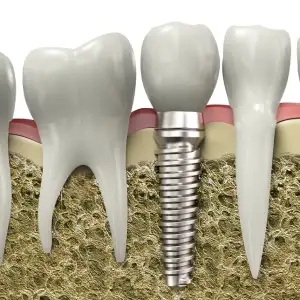
An implant depends on two things holding up over decades. The first is osseointegration — living bone growing into direct contact with the implant surface and remodeling around it. The second is the peri-implant seal, the collar of soft tissue that adapts to the implant and functions as a biological barrier keeping oral bacteria out of the bone-implant interface. Smoking attacks both.
- Nicotine-induced vasoconstriction — Nicotine causes peripheral blood vessels to narrow, reducing perfusion to the tissues at the surgical site. New bone formation and soft-tissue healing are both metabolically expensive processes that depend on oxygen, nutrient delivery, and immune cell traffic. Less blood flow slows all of it. This is the central mechanism, and it is the reason nicotine matters regardless of how it is delivered.
- Carbon monoxide and reduced oxygen carrying capacity — Carbon monoxide in smoke binds hemoglobin far more readily than oxygen does, further lowering the oxygen actually available to healing tissue. Combustion adds this insult on top of the vascular one.
- Heat and combustion byproducts on the mucosa — The gingival tissue that has to form a seal around the implant is directly exposed to hot smoke and a long list of irritants. Keratinization changes, the tissue becomes more fibrotic and less well vascularized, and the quality of the attachment suffers.
- Blunted immune function — Neutrophil chemotaxis and phagocytosis are impaired in smokers, which reduces the local defense against bacterial colonization at exactly the site where colonization is most consequential.
- Altered bone metabolism — Smoking is associated with reduced osteoblast activity and increased bone resorption. Marginal bone loss around implants is commonly reported to progress faster in smokers over the years following placement.
Every item on that list converges on the same two targets. That is why the effect is real rather than statistical noise, and it is also why the effect is graded — heavier and longer exposure produces more of it.
Why Grafted Sites and Sinus Lifts Carry Disproportionate Risk
If there is one section of this article worth reading twice, it is this one.
A native bone site already has an established blood supply. When an implant is placed into it, healing is a matter of remodeling around a foreign surface within tissue that is already vascularized. That is demanding, but the infrastructure exists.
A bone graft has no blood supply at all when it is placed. Whether it is particulate graft material in a ridge augmentation, a block graft secured with fixation screws, or graft material elevated into the sinus cavity during a sinus lift, the graft begins as a scaffold. It only becomes living bone through angiogenesis — new capillaries growing in from the surrounding host bone and periosteum, carrying the cells that resorb the scaffold and lay down new bone in its place. That process is the entire mechanism by which grafting works.
Vasoconstriction targets exactly that process. Reducing microvascular flow into a site whose survival depends on new vessel ingrowth is a direct hit to the biology, not a peripheral effect. This is why smoking is reported as a stronger risk factor for graft complications and sinus augmentation problems than for straightforward placement in native bone, and why membrane exposure and graft loss appear more frequently in smokers.
It is also why the conversation is different depending on what your case needs. A single implant into good native mandibular bone in a light smoker is a manageable situation. A staged bone grafting case with a sinus lift in the posterior maxilla in a heavy smoker is a case where the risk discussion has to be explicit and where planning changes meaningfully.
What About Vaping, Heated Tobacco, and Nicotine Pouches?
Patients ask this often, usually hoping for a clean answer. The honest one has two halves.
The first half: nicotine’s vascular effect is the primary mechanism, and nicotine is nicotine regardless of delivery. Vaping, heated tobacco products, nicotine pouches, and nicotine replacement therapy all deliver the compound that constricts blood vessels. None of them is a free pass on the central biological problem.
The second half: they are genuinely not identical to cigarettes either. Removing combustion removes carbon monoxide, tar, and the thermal insult to the mucosa, which are real contributors. It would be inaccurate to tell you vaping is exactly as harmful to an implant as smoking.
| Delivery method | Mechanisms present | What the evidence base looks like |
|---|---|---|
| Cigarettes | Nicotine vasoconstriction, carbon monoxide, heat, tar and combustion byproducts, direct mucosal exposure | Large and long-established. This is where the two-to-three-times figure comes from. |
| Vaping and heated tobacco | Nicotine vasoconstriction, aerosol and heat exposure to oral mucosa; no combustion products | Younger and thinner. Emerging work points to real peri-implant and periodontal effects, but long-horizon implant data is still accumulating. |
| Nicotine pouches and smokeless tobacco | Nicotine vasoconstriction plus sustained local contact with the gingiva at the placement site | Limited implant-specific evidence. Local soft-tissue effects and recession at the habitual placement site are well described. |
| Nicotine replacement therapy | Nicotine vasoconstriction only; no combustion, no heat, no mucosal irritation | Used specifically to support quitting. Whether and how to use it is a decision for your physician, not your dental team. |
The practical position: tell us what you actually use, in what quantity. Switching from cigarettes to a non-combusted product removes some of the mechanisms and is worth something. It does not remove the vascular one, and it should be disclosed rather than treated as equivalent to not using nicotine.
Does Quitting Before Surgery Actually Help?
Yes, and meaningfully — with a caveat that deserves to be stated plainly rather than buried.
The vascular effects of nicotine are relatively short-lived. Circulation to peripheral tissue begins improving within days of the last exposure, and carbon monoxide clears from the bloodstream within roughly a day. That means a period of abstinence surrounding surgery genuinely improves the healing environment during the window when it matters most. Protocols that ask patients to stop for a period before and after surgery exist because that window is when angiogenesis and early integration occur. Your surgeon will give you the specific timeframe for your case.
The caveat: quitting does not reset you to a non-smoker’s baseline. Longer-term smoking produces changes that do not reverse on a short timescale — altered gingival vascularity and tissue quality, existing marginal bone loss, and an established periodontal picture. Studies looking at former smokers generally place them between current smokers and never-smokers rather than alongside never-smokers, with the gap narrowing the longer the abstinence lasts.
That is not an argument against quitting. It is an argument for accurate expectations. A patient who quits for surgery has improved their odds substantially. A patient who quits permanently improves them further, over years, and also protects the natural teeth and gum tissue that surround the implant.
Smokers Are Not Refused Treatment — Here Is What Changes Instead
Refusing to treat patients who smoke would exclude a large number of people who need implants, often precisely because smoking contributed to the tooth loss in the first place. That is not how we practice. What changes is the plan.
- The risk conversation happens up front and in writing — Including the honest range of outcomes and what happens if an implant does fail. No surprises later.
- Site selection is more conservative — Where there is a choice, implants are favored in sites with better native bone and better blood supply. The posterior maxilla is approached with more caution.
- Staged approaches are preferred over immediate ones — Immediate placement and immediate loading compress biological demand into a shorter window. Separating the stages gives each one more room.
- Grafting is planned with extended timelines — Longer healing before the next stage, and closer monitoring of graft sites and membrane coverage.
- Soft-tissue management gets more attention — Tension-free primary closure, and attention to the band of keratinized tissue around the implant, which contributes to a more durable seal.
- Periodontal health is stabilized first — Smoking and periodontal disease travel together, and smoking masks bleeding, which means gum disease often looks quieter than it is. Consistent gum care is a prerequisite rather than an add-on.
- Maintenance intervals are shortened — Typically three to four months rather than six, because early peri-implant inflammation needs to be caught while it is still reversible.
What Long-Term Maintenance Should Look Like
Most implant failures in smokers are not dramatic early events. They are slow — gradual marginal bone loss, progressive peri-implant inflammation, and a problem that becomes obvious years after placement. That pattern is the reason maintenance matters more here than almost anywhere else.
Expect a shorter recall interval, periodic radiographs to track marginal bone levels rather than only visual inspection, probing around the implant to detect inflammation early, and a restoration designed so you can physically clean around it. Report bleeding, tenderness, swelling, or any change in how the restoration feels rather than waiting for the next appointment.
If an implant does develop problems, options exist. Peri-implant inflammation caught early is often manageable. When an implant has already failed or is failing, failed implant rescue addresses the defect, the cause, and the plan for the site — a different discussion from candidacy, but a reassuring one to know exists.
Frequently Asked Questions
Will my surgeon be able to tell if I smoke?
Usually, from tissue appearance and healing pattern. The more useful point is that accurate disclosure changes the plan in your favor. Knowing you smoke leads to more conservative site selection, extended healing intervals, and a maintenance schedule matched to the actual risk. Understating it means being planned for as a lower-risk patient than you are, which serves no one.
Is the risk worse in the upper jaw than the lower?
Studies commonly report a stronger effect in the maxilla. The upper jaw generally has lower bone density than the mandible, is more often the site of sinus augmentation and grafting, and offers less mechanical support to begin with. Where a case involves the posterior maxilla and grafting together, the risk factors compound rather than simply add.
Should I just get dentures instead if I smoke?
Not necessarily, and there is a trade-off worth understanding. Removable dentures place pressure on the ridge without providing the internal stimulation that maintains bone, so resorption tends to continue underneath them. Smoking is a reason to plan an implant case carefully and maintain it closely. On its own it is rarely a reason to abandon the option.
How long after quitting am I considered a non-smoker for surgical purposes?
There is no fixed line, and different sources use different intervals. The vascular effects of nicotine ease within days, which is why abstinence around the surgical window is emphasized. The broader tissue changes from long-term smoking resolve over a much longer horizon, and former smokers are generally regarded as sitting between current and never-smokers. Your surgeon will set expectations based on your history.
Have the Real Conversation Before You Decide
Smoking raises implant risk. It does not make you a bad candidate by default, and it does not make you unwelcome here. What it does mean is that your case deserves 3D imaging, honest numbers, a plan built around slower healing, and a maintenance schedule that matches the risk you are actually carrying. Schedule a consultation and tell us exactly what you use — we will plan around the truth rather than around an assumption. Patients considering dental implants in Aventura and the surrounding communities can start with a straightforward evaluation.
Center for Dental Implants welcomes patients from across South Florida, with offices in Aventura, Hallandale Beach, and Pembroke Pines.