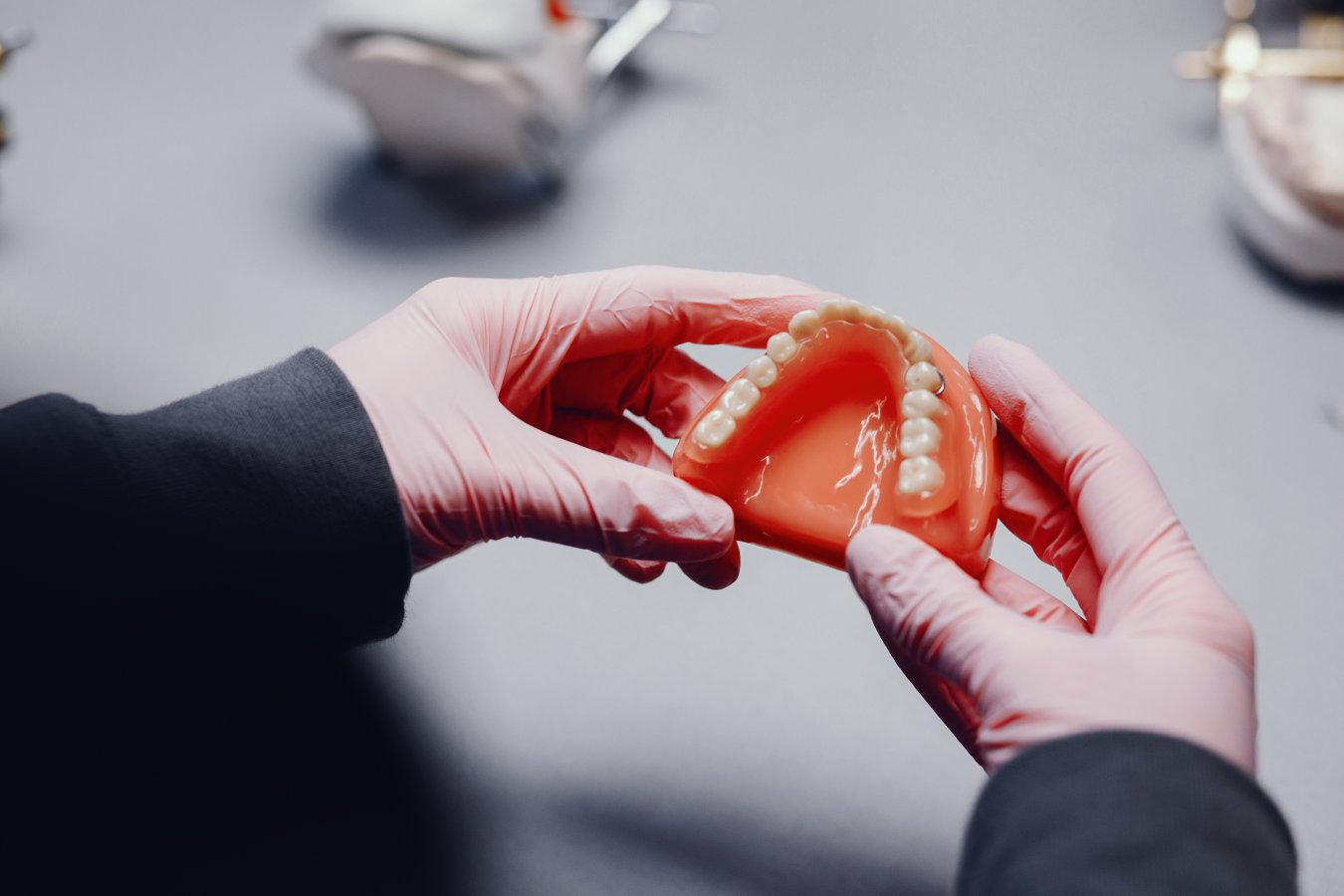
The difference comes down to one thing: who takes it out. A fixed full-arch bridge is screwed onto your implants and stays in your mouth permanently — only your dentist can remove it, using a specific tool, at a maintenance visit. A removable implant overdenture snaps onto attachments on your implants and is designed for you to take out yourself, every night, for cleaning. That single design decision drives everything else: how much bite force you get back, how much bulk sits against your palate and gums, how many implants are needed, what wears out and how often, and what the whole thing costs over ten years. Neither option is better in the abstract. One of them is usually a better fit for your bone, your hands, your priorities, and your budget.
Why Patients Get Stuck on This Decision
One of the most common questions patients ask during a full-arch consultation is some version of: “Should I get the kind that comes out, or the kind that stays in?”
It is usually asked with an assumption attached — that the fixed option is simply the better one and the removable option is what you settle for. That framing is not quite right. Fixed restorations do restore more function, and for many patients they are the right recommendation. But overdentures solve real problems that fixed bridges do not, particularly for patients with limited bone, patients who need a less invasive surgical footprint, and patients for whom being able to clean the whole appliance in their hands each night is a genuine advantage rather than an inconvenience.
The useful comparison is not “which is better,” but “which set of trade-offs matches your situation.”
Removability: What It Actually Means Day to Day
With a fixed full-arch bridge, the prosthesis is retained by screws that pass through the teeth into the implant abutments, or by a screw-retained framework attached to multi-unit abutments. The access holes are filled with tooth-colored composite. You brush it, floss under it, and irrigate around it — but it does not come out for you. Your dentist removes it periodically, typically once or twice a year, to clean the tissue surface and inspect the components underneath.
With an overdenture, the prosthesis clips onto attachments — commonly locator-style abutments or a bar with clips — and you take it out yourself. Most patients remove it at night, clean it over a sink, and leave it soaking. The tissue underneath gets a rest period, and any food that worked its way under during the day comes out with it.
Patients describe the psychological difference more often than the mechanical one. Some strongly prefer teeth that never leave their mouth. Others find real reassurance in being able to see and scrub every surface of the appliance directly.
How Much Chewing Function Does Each One Restore?
This is where the two diverge most sharply, and it is worth understanding the mechanism rather than memorizing a number.
A conventional denture rests on soft tissue. When you bite down, the force compresses gum tissue against bone, which is uncomfortable well before the denture reaches the load a natural bite can generate. That is why denture wearers avoid apples, steak, and crusty bread — not because the denture will break, but because the tissue underneath cannot tolerate the pressure.
An overdenture improves on this substantially. The attachments hold the prosthesis in place so it does not lift or rock, which removes the instability that makes chewing tentative. But most overdenture designs are still partly tissue-borne — a share of the load still passes through the gums. Function improves greatly compared with a conventional denture; it does not fully match a fixed restoration.
A fixed full-arch bridge transfers essentially all chewing force directly into the implants and through them into bone. Nothing presses on the gums. Studies commonly cited in the implant literature report that fixed implant-supported restorations restore substantially greater maximum bite force than removable options, approaching the range associated with natural dentition, while overdentures land meaningfully above conventional dentures but below fixed. In plain terms: patients with fixed bridges generally report eating whatever they want without thinking about it. Overdenture patients report eating far better than they did with a denture, while still being somewhat deliberate about the hardest foods.
Comfort, Bulk, and the Palate Question
An upper conventional denture covers the roof of the mouth because it relies on suction against the palate for retention. That coverage blunts taste and dulls the sensation of temperature, and for some patients it triggers a gag response.
Because an upper overdenture is retained by implants rather than suction, the palate can often be opened into a horseshoe shape. Whether it can be fully opened depends on implant number and distribution — with only two implants, some palatal coverage is often retained for stability; with four or more well-distributed implants, a fully open horseshoe design becomes more feasible.
A fixed upper bridge has no palatal component at all. The prosthesis follows the ridge and nothing else. Patients who move from a full upper denture to a fixed bridge frequently comment on tasting food properly for the first time in years.
Bulk differs too. Overdentures need a certain thickness of acrylic to house the attachment housings without fracturing around them, which means they are physically thicker than a fixed bridge in most areas. Fixed bridges can be milled thinner because the framework carries the strength.
How Many Implants Does Each Option Need?
Implant count is a structural question, and the two designs sit at different points on that scale.
- Lower overdenture — Commonly two implants in the front of the lower jaw, where bone is typically densest. Four implants are used where more stability is wanted or where the ridge is heavily resorbed.
- Upper overdenture — Generally requires more than the lower, often four or more, because upper jaw bone is usually less dense and the appliance is fighting gravity rather than being helped by it.
- Fixed full-arch bridge — Typically four to six implants per arch, and sometimes more where the arch is long, the opposing bite is strong, or the plan calls for segmenting the restoration into sections for easier future repair.
More implants means more surgery and more cost, but it also means load is spread more widely and any single implant carries less demand. Where bone volume is insufficient for the number of implants a fixed design requires, bone grafting can often rebuild the ridge to make it possible — which shifts the conversation from “which option” to “which option, and in what sequence.”
Maintenance: What Wears Out and When
Both options need professional maintenance. They need different kinds of it, and this is the factor patients are least often told about in advance.
Overdentures have consumable parts. The nylon or rubber inserts inside locator-style attachments — and the clips on bar-retained designs — are engineered to wear. That wear is by design: the insert is the sacrificial component, protecting the implant and the abutment from the stress of repeated insertion and removal. Inserts typically need replacement periodically, and the interval varies with bite force, how often the appliance is removed, and the retention level chosen. Replacement is a quick chairside procedure, but it is a recurring one. Over a decade, an overdenture patient should expect multiple attachment changes, and possibly a reline as the underlying ridge continues to change shape.
Fixed bridges have different maintenance needs. Screws can loosen and need retorquing. Acrylic teeth on a hybrid framework can chip and require repair. The prosthesis is unscrewed periodically for a thorough cleaning of the tissue surface. And because you cannot take it out to inspect it, hygiene under the bridge has to be actively managed with floss threaders, interdental brushes, and a water flosser — a routine we cover in detail in our guidance on implant restoration care and long-term maintenance.
Fixed Full-Arch Bridge vs. Removable Overdenture
| Factor | Fixed Full-Arch Bridge | Removable Implant Overdenture |
|---|---|---|
| Who removes it | Dentist only, at maintenance visits | You, daily |
| Chewing function | Substantially greater; force goes into implants, not gums | Much better than a denture; partly tissue-borne |
| Palate coverage (upper) | None | Often open horseshoe; depends on implant number |
| Bulk | Thinner; framework provides strength | Thicker acrylic to house attachments |
| Implants per arch | Typically 4–6, sometimes more | 2–4 lower; often 4 or more upper |
| Recurring maintenance | Screw checks, periodic removal and cleaning, occasional tooth repair | Attachment insert replacement, occasional relines |
| Daily hygiene demand | Higher skill required — cleaning under a bridge you cannot see | Simpler — clean the appliance in hand, brush the abutments |
| Upfront cost | Higher; varies widely by materials and implant count | Lower; varies widely by implant count and design |
| Bone requirement | Greater; more implants, more sites needing volume | Lower; fewer implants, often in the densest bone |
Cost, and What It Looks Like Over Ten Years
Upfront, an overdenture is generally the less expensive option. Fewer implants, fewer components, and a simpler laboratory process all contribute. A fixed full-arch bridge typically costs meaningfully more per arch, with the gap widening as implant count rises and as the prosthesis material moves from acrylic to milled zirconia. Both ranges vary widely by case complexity and by what a given quote includes, so treat any single figure as a starting point for a conversation rather than an answer.
Total cost of ownership tells a slightly different story. Over ten years, the overdenture accrues recurring costs: attachment inserts replaced on a repeating cycle, at least one reline as the ridge remodels, and often a replacement of the acrylic prosthesis itself as teeth wear. The fixed bridge accrues fewer but sometimes larger interventions: screw maintenance, occasional repair of chipped teeth, and — with an acrylic hybrid — the possibility of replacing the prosthetic teeth after years of wear.
The gap narrows over time. It rarely closes. Patients choosing an overdenture primarily on price should budget for maintenance rather than assuming the initial figure is the whole picture.
A Decision Framework
Choose a fixed full-arch bridge if…
- Stability is your top priority — You want teeth that never move, never come out, and never need to be thought about mid-meal.
- You have or can build adequate bone — Enough volume for four to six implants per arch, natively or after grafting.
- Chewing performance matters most — Especially if you are chewing against natural teeth in the opposing arch.
- You can manage the hygiene routine — Threading floss and using a water flosser under a bridge daily, reliably.
Choose a removable overdenture if…
- Bone volume is limited and grafting is not the right path — Whether for medical, financial, or personal reasons.
- Budget is a defining constraint — And a substantial functional improvement over a conventional denture is the goal.
- Hand dexterity is a factor — Arthritis, tremor, or reduced grip strength can make threading floss under a fixed bridge genuinely difficult. Cleaning an appliance held in your hand is easier. Note that severely limited dexterity can also make inserting and removing an overdenture difficult, so this needs to be assessed individually.
- A caregiver assists with oral hygiene — A removable appliance is far simpler for someone else to clean thoroughly.
- You want fewer surgical sites — Two to four implants rather than four to six.
These are general considerations rather than a diagnosis. The right answer for you depends on a clinical exam, CBCT imaging that shows what your bone will actually support, and a frank conversation about how you live. Any medical conditions or medications that affect bone healing should also be reviewed with your physician as part of that planning.
Where the Two Paths Meet
It is worth knowing that this is not always a permanent fork. Some patients begin with an overdenture and later convert to a fixed restoration after grafting builds additional bone or after finances allow. Some do the reverse for comfort or maintenance reasons. And in many cases the two coexist — a fixed lower bridge against an upper overdenture is a common and well-functioning combination, because the lower jaw usually offers denser bone and the upper benefits from the broader tissue support.
Deciding well means starting from diagnosis. In our practice, full-arch planning begins with CBCT 3D imaging and digital treatment planning, so the prosthetic design and the implant positions are decided together rather than sequentially. Dr. Arun K. Garg — who spent over 20 years as a full-time professor of surgery and director of residency training in the Division of Oral and Maxillofacial Surgery at the University of Miami Leonard M. Miller School of Medicine, and who is considered the world’s preeminent authority on bone biology and grafting for implant dentistry — evaluates bone first. What the bone will support shapes which restoration is realistic, and where a broader plan is needed, that evaluation extends into a full reconstruction of both arches.
Frequently Asked Questions
Can an overdenture be converted to a fixed bridge later?
Sometimes. It depends on how many implants are present, where they sit, and whether their positions suit a fixed design. Implants placed for a two-implant overdenture are usually too few and too far forward to support a fixed bridge without adding more. If conversion is a possibility you want to keep open, say so during planning so implant positions can be chosen with that in mind.
Will a fixed bridge feel like my natural teeth?
Closer than any removable option, but not identical. Implants have no periodontal ligament, so the fine pressure sensing that natural teeth provide is absent — most patients adapt within weeks and stop noticing. Chewing confidence typically returns quickly. Speech usually normalizes within the first few weeks as the tongue adjusts to the new contours.
How often do overdenture attachments need replacing?
It varies considerably with bite force, how frequently the appliance is inserted and removed, and the retention strength chosen. Many patients need inserts changed once or twice a year; some go longer. Loss of snap or a prosthesis that lifts while eating is the usual signal. It is a short, straightforward chairside visit.
Is one option better if I grind my teeth?
Heavy grinding influences both, differently. It accelerates wear on overdenture attachments and acrylic teeth, and it raises the load a fixed framework must tolerate, which may argue for more implants and a stronger prosthesis material. Either way, a nightguard or a protective appliance is often part of the plan, and your surgeon should factor grinding into the design from the start.
Talk Through Both Options Before You Commit
The right full-arch restoration is the one your bone can support and your daily routine can sustain. If you are weighing these two paths, schedule a complimentary implant consultation and see what the imaging shows before deciding.
Center for Dental Implants welcomes patients from across South Florida, with offices in Aventura, Hallandale Beach, and Pembroke Pines.