Many general dentists place dental implants competently, and a single implant in a healthy, well-shaped ridge is often well within that scope. The real question is not whether a general dentist is permitted to place implants — every licensed dentist is — but whether the specific case in front of you matches the surgical training of the person planning it. Cases involving significant bone loss, sinus proximity, the front of the mouth, full-arch reconstruction, complicated medical histories, or a previously failed implant call for surgical training measured in years of hospital residency rather than hours of coursework. The honest way to choose a provider is to match the complexity of your case to the depth of surgical experience it genuinely requires.
Is a General Dentist Allowed to Place Dental Implants?
Yes. In the United States, implant placement falls within the general scope of dental licensure. There is no separate license required, and no state limits implant surgery to a defined specialty. That surprises many patients, who assume the procedure is restricted the way certain medical procedures are.
This is not a loophole, and it is not a problem in itself. Dentistry has always allowed practitioners to expand their scope through post-graduate education, and a great many general dentists have done exactly that — thoughtfully, over years, with mentorship and careful case selection. Some of the most conscientious implant clinicians we know are general dentists who place a modest number of well-chosen cases each year and refer the rest.
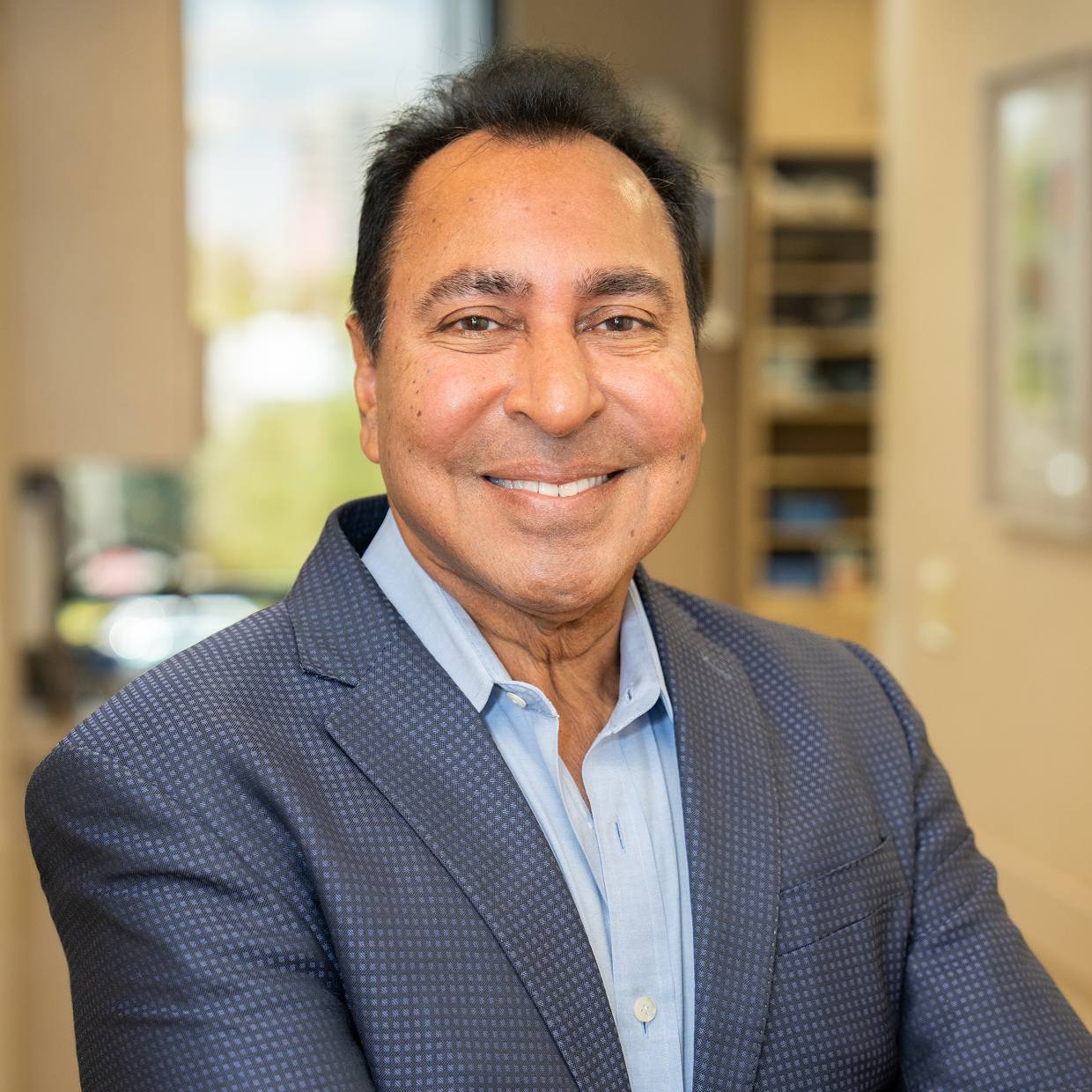
Dr. Arun K. Garg has spent much of his career teaching those clinicians. He has trained more than 20,000 dentists in implant and grafting protocols, and the reason that work matters is straightforward: raising the standard of care across the whole profession helps far more patients than any single surgeon can treat. So the framework below is not an argument that general dentists should stay away from implants. It is a framework for telling one kind of case from another.
What Is the Actual Training Difference?
Here is the part that rarely gets explained clearly. Implant placement is not itself a recognized dental specialty. There is no “implantologist” board in the way there is a board for oral and maxillofacial surgery or periodontics. What exists instead is a very wide range of surgical preparation, and the range is genuinely wide:
- Continuing-education courses — Weekend or multi-day programs, sometimes with live surgery, sometimes with models only. These can be excellent, and they are how a large share of clinicians begin. Depth depends entirely on the program and on what the clinician does afterward.
- Structured mini-residencies and fellowships — Longer programs, often a year of part-time study, with supervised placement. A meaningful step up in both surgical volume and complication management.
- Multi-year hospital residency — Oral and maxillofacial surgery and periodontics residencies run several years full time. Residents manage anesthesia, infection, trauma, medically complex patients, grafting, and — importantly — the cases that go wrong.
The distinction that matters most is not how many implants a clinician has placed successfully. It is how much training they have in what to do when a case stops being routine mid-procedure. A sinus membrane tears. The bone is softer than the imaging suggested. Primary stability is not achieved. A patient’s blood pressure climbs. Residency training is largely an education in managing those moments under supervision, hundreds of times, before doing it alone.
Which Implant Cases Are Genuinely Straightforward?
Plenty of them. A case is reasonably described as straightforward when most of the following are true:
- A single missing tooth in the back of the mouth, where the neighboring teeth are healthy and stable.
- Adequate bone in three dimensions — enough height and enough width, confirmed by 3D imaging, with no grafting required.
- Comfortable distance from anatomy — the inferior alveolar nerve canal and the sinus floor are both well clear of the planned implant position.
- Healthy gum tissue with no active periodontal disease and no infection at the site.
- A medically uncomplicated patient with well-controlled general health and no medications that affect bone turnover or healing.
- A predictable restorative endpoint — the crown that will sit on the implant can be designed conventionally, without unusual angulation or cosmetic demands.
When those conditions line up, a well-trained general dentist with good imaging, careful planning, and honest case selection can produce an excellent result. There is nothing second-rate about that pathway.
Which Cases Call for Specialist-Level Surgical Training?
The picture changes when the anatomy, the biology, or the aesthetic demand stops being forgiving. These are the situations where the depth of surgical training tends to show:
- Significant bone loss — When the ridge has resorbed in height, width, or both, the case is no longer an implant case. It is a reconstruction case that ends with an implant. Ridge augmentation, block grafting, and biologic techniques each carry their own judgment calls.
- Sinus proximity in the upper back jaw — Placing an implant near or into the sinus floor requires either a lateral or crestal sinus lift, and the ability to manage a torn membrane without abandoning the procedure.
- The aesthetic zone — Front teeth are unforgiving. Implant position, gum contour, and the thickness of the tissue over the implant determine whether the result looks like a tooth or like a restoration. Soft-tissue grafting is often part of the plan.
- Full-arch reconstruction — Multiple implants must be positioned in relation to one another with tolerances that a single crown never demands, and the prosthesis has to fit all of them passively.
- Medically complex patients — Poorly controlled diabetes, a history of head-and-neck radiation, immune suppression, or medications that alter bone metabolism all change surgical risk and healing behavior. These cases require physician coordination, not just surgical skill.
- Revision of a failed implant — A failed implant almost always leaves a bone defect, sometimes an infected one. Removing hardware, reconstructing the site, and re-establishing a stable foundation is among the most technically demanding work in implant dentistry.
If you have been told your case is one of these and also been told it is simple, those two statements are hard to reconcile — and it is fair to ask for the reasoning behind both. Some of what we treat is exactly this: cases that turned out to be more complicated than they first appeared.
Matching Case Complexity to Surgical Training
This table is a general orientation, not a rule. Individual anatomy overrides any category.
| Case Type | What Makes It Demanding | Surgical Training It Typically Calls For |
|---|---|---|
| Single back tooth, ample bone, healthy gums | Little — anatomy is forgiving and the restoration is conventional | A general dentist with formal implant training, 3D imaging, and honest case selection |
| Single tooth needing minor grafting at placement | Simultaneous graft and implant; healing must be managed together | Advanced implant training with regular grafting experience, or specialist referral |
| Front tooth in the aesthetic zone | Gum contour and thin tissue determine the visible result | Specialist-level surgical and soft-tissue training, with restorative planning up front |
| Upper back jaw with limited height under the sinus | Sinus lift required; membrane complications must be managed live | Oral and maxillofacial surgeon or periodontist with routine sinus grafting volume |
| Significant ridge resorption requiring reconstruction | Bone must be rebuilt in three dimensions before implants are possible | Residency-trained surgeon with dedicated grafting expertise |
| Full-arch reconstruction | Multiple implants must relate to each other and to a prosthesis that fits passively | Residency-trained surgeon working with a coordinated restorative and laboratory team |
| Medically complex patient | Healing, infection risk, and bone biology are all altered | Hospital-trained surgeon coordinating with the patient’s physician |
| Revision of a failed implant | Hardware removal, infection control, and defect reconstruction in one plan | Residency-trained surgeon with high revision-case volume |
What Does Each Specialty Actually Bring?
Oral and Maxillofacial Surgeon
Several years of hospital-based residency covering anesthesia, facial trauma, pathology, infection management, and reconstructive grafting. The training is surgical first. For medically complex patients, extensive bone reconstruction, and cases where sedation or general anesthesia is part of the plan, this background is directly relevant.
Periodontist
A multi-year residency centered on the tissues that hold teeth in place — bone and gum. Periodontists bring particular strength in soft-tissue management, treating the gum disease that caused the bone loss in the first place, and site development in the aesthetic zone where tissue contour decides the result.
Prosthodontist
A multi-year residency in restoration and full-mouth rehabilitation. Prosthodontists are the specialists of the tooth itself — how it looks, how it loads, how a full-arch prosthesis distributes force. Some place implants; many focus on designing what goes on top of them, which in complex cases is the harder half of the problem.
How the Surgical and Restorative Roles Get Split
In much of implant dentistry, two clinicians share a case: one places the implant, another builds the tooth. That model works well when the two communicate closely and plan together from the start. It works poorly when the implant is placed first and the restoring dentist is handed a position they cannot build on. The sequence that consistently produces better results is the reverse — plan the final tooth, then place the implant where that tooth requires it. That is one of the practical arguments for having surgical and restorative planning happen under one roof, where the conversation is a walk down the hallway rather than a referral letter.
What Should You Ask Before Agreeing to Surgery?
These questions are not about challenging anyone’s credentials. They are about establishing how complex your case is and whether the plan reflects that. A confident clinician will answer them readily, and a good one may volunteer a referral.
- “How would you rate the complexity of my case, and why?” — The reasoning matters more than the rating.
- “How many cases like mine do you treat in a typical month?” — Not implants in general. Cases like yours.
- “Will I need grafting, and if so, what kind?” — A clear answer requires 3D imaging, not a guess.
- “What is your plan if the bone is different from what the scan suggests?” — This tests for a contingency plan, which is the real marker of surgical depth.
- “Who will restore the implant, and when will they be involved in planning?” — Ideally, before surgery.
- “At what point would you refer a case like mine?” — Every honest clinician has a threshold. Hearing it is reassuring.
Why Case Volume Matters More Than the Letters After a Name
Credentials describe where someone trained. Volume describes what they do now. A periodontist who places two implants a month and an oral surgeon who places several a day are both specialists, and they are not equivalently prepared for a difficult reconstruction.
What repeated exposure builds is pattern recognition — the ability to notice, early, that a case is drifting away from the plan. Surgeons who see complexity daily tend to anticipate problems at the imaging stage rather than discover them in the chair. That is also why some patients decide the extra drive is worth it and travel some distance for care rather than choosing on proximity alone.
So ask about complexity and frequency together. “How often do you handle this specific situation?” is a more revealing question than any credential list, and it is a question anyone can ask without giving offense.
Frequently Asked Questions
Is it a red flag if my general dentist offers to place my implant?
Not at all. Many general dentists have substantial implant training and place straightforward cases with excellent results. What matters is whether your specific case is straightforward. Ask how they assessed complexity, whether 3D imaging was used, and at what point they would refer. A thoughtful answer to those questions is far more informative than the provider’s title.
Do I need a specialist for a single missing tooth?
Often not. A single back tooth with adequate bone, healthy gums, and no anatomical constraints is one of the more predictable procedures in dentistry. Specialist involvement becomes more valuable when grafting is needed, when the tooth is in the visible smile line, or when the site sits close to the sinus or nerve canal.
Which specialist should place an implant — an oral surgeon or a periodontist?
Both are trained to place implants, and the better choice depends on the case. Extensive bone reconstruction, medically complex patients, and cases requiring deeper sedation often suit an oral and maxillofacial surgeon. Cases driven by gum disease or by soft-tissue contour in the aesthetic zone often suit a periodontist. Case volume in your specific situation is the deciding factor.
My implant failed. Does that change who should treat me?
Generally, yes. A failed implant usually leaves a bone defect and sometimes residual infection, so the revision is a reconstruction rather than a repeat of the original procedure. These cases benefit from a surgeon who performs revision work regularly and who can evaluate why the first implant failed before planning a second.
Find Out What Kind of Case You Actually Have
The most useful thing you can leave a consultation with is not a recommendation but an explanation — what your bone looks like in three dimensions, where the difficult parts of your case are, and what level of surgical planning those parts require. Dr. Arun K. Garg spent over 20 years as a full-time professor of surgery and director of residency training in the Division of Oral and Maxillofacial Surgery at the University of Miami Leonard M. Miller School of Medicine, and much of that career has been spent on exactly this question of when a case needs more. You are welcome to schedule a consultation and get a candid read on yours.
Center for Dental Implants welcomes patients from across South Florida, with offices in Aventura, Hallandale Beach, and Pembroke Pines.