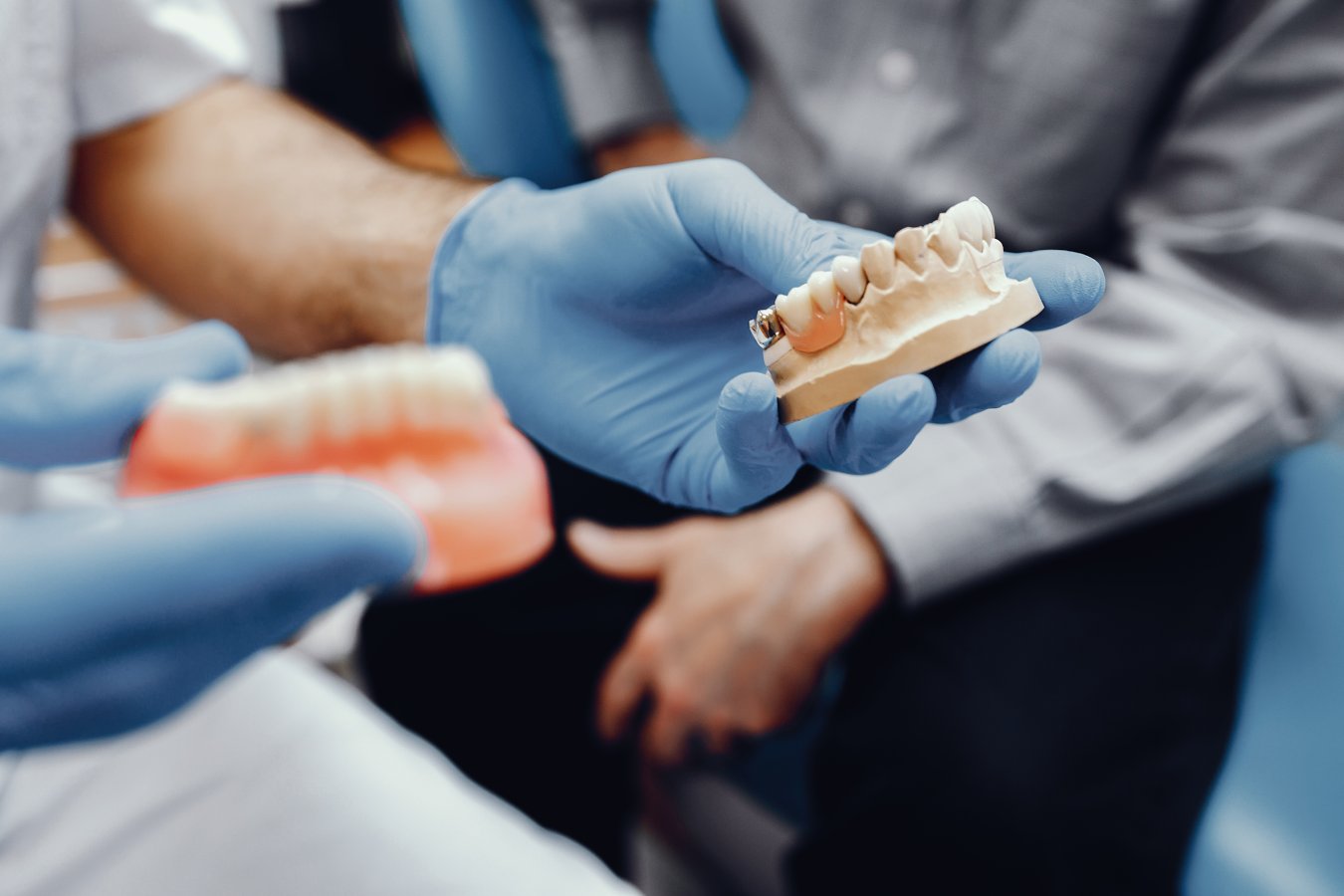
A hybrid denture is a full arch of replacement teeth built onto a rigid framework and screwed directly onto dental implants. Despite the name, it is not a denture in the way most people mean the word — you do not take it out, it does not rest on your gums for support, and it uses no adhesive. It stays in your mouth permanently and can only be removed by your dentist, with a driver, at a maintenance visit. The word “hybrid” refers to how it is made: it combines denture-style teeth and prosthetic material with implant-bridge engineering. Functionally, it behaves like a fixed bridge. It just happens to look, from the outside, like a very good denture.
Why Does This One Thing Have So Many Names?
One of the most common questions patients ask during a full-arch consultation is some version of: “I’ve heard hybrid denture, fixed detachable, All-on-X, and implant bridge — are those four different things?”
In most conversations, no. They are largely different names for closely related restorations, and the variation comes from who is speaking rather than from any deep clinical distinction.
- Hybrid denture — The laboratory and prosthodontic term. Describes the construction: denture teeth and base material combined with a metal or milled substructure.
- Fixed detachable — The most technically accurate name. “Fixed” for the patient, “detachable” for the clinician. It captures the one fact patients most need to know.
- Screw-retained denture — Describes the retention mechanism. Screws pass through access channels in the prosthesis into the implant abutments and are torqued to specification.
- Implant bridge or full-arch implant bridge — Emphasizes that it functions as a bridge spanning between implant supports rather than resting on tissue.
- All-on-X — Names the surgical protocol underneath rather than the prosthesis itself. All-on-4 means four implants, All-on-6 means six. The prosthesis sitting on top is usually a hybrid.
There are genuine differences in materials, implant count, and framework design between individual cases. But if a practice tells you they are recommending a fixed detachable and another calls the same restoration a hybrid, you are not being offered two different treatments.
How a Hybrid Denture Is Built
The construction has three layers, and understanding them explains almost everything about how the restoration behaves.
The implants. Typically four to six per arch, placed where bone volume and density allow. In many upper-arch cases and in patients with heavy bite forces, six implants are preferred over four to distribute load and shorten the unsupported segment behind the last implant.
The framework. A rigid substructure — historically a cast or milled titanium bar, increasingly a milled titanium or zirconia structure produced from a digital scan — spans between the implants. This is the load-bearing element. It splints the implants together so that force applied to one tooth is shared across all of them rather than concentrated on the nearest fixture.
The teeth and base. Prosthetic teeth and gum-colored material are carried on the framework, contoured to restore both the tooth position and the soft-tissue profile that has been lost through resorption. That pink portion is doing real work: it replaces the ridge volume that no longer exists, supporting the lip and cheek.
Access channels run through the biting surfaces or the tongue side of the prosthesis to the screws below. Once torqued, the channels are sealed with composite. Most patients cannot find them without being shown.
Materials, at a high level
Two families dominate. An acrylic hybrid uses acrylic denture teeth and acrylic base material bonded to a titanium bar — lighter, more forgiving, and repairable chairside if a tooth chips. A monolithic zirconia prosthesis is milled from a single block of high-strength ceramic — denser, far more resistant to wear and staining, and heavier in the hand. Which one suits a given patient depends on bite force, esthetic priorities, budget, and whether the restoration is intended as an interim or a definitive prosthesis. That choice deserves its own conversation with your surgeon; it is not a detail to leave to the laboratory.
How It Differs From a Conventional Denture
A conventional full denture is a tissue-borne appliance. It rests on the gum ridge and, in the upper arch, relies on suction against the palate to stay in place. Every bite compresses soft tissue against bone. Nothing anchors it. And critically, the pressure it applies to the ridge accelerates bone resorption rather than preventing it — which is why long-term denture wearers see the fit deteriorate year after year as the very ridge the denture depends on continues to shrink.
A hybrid denture reverses that relationship. Chewing force travels through the prosthesis into the framework, into the implants, and into bone. Because the implants transmit load into the jaw the way natural tooth roots do, they provide the mechanical stimulation bone needs to maintain its density and volume in the regions where they are placed. Bone preservation is not a side benefit here — it is one of the strongest clinical arguments for the design.
How It Differs From a Removable Overdenture
This is the comparison that trips patients up, because both are implant-supported and both may look similar in a photograph.
An overdenture snaps onto attachments on the implants and you remove it — typically every night. Part of its support still comes from the tissue underneath. It is thicker, because the acrylic has to house the attachment components without cracking around them.
A hybrid is screwed down and stays put. Support is entirely implant-borne. It can be built thinner because the framework provides strength rather than bulk. And the daily maintenance burden shifts from the appliance to the mouth: instead of cleaning something you hold in your hand, you have to clean underneath something you cannot remove.
Conventional Denture vs. Removable Overdenture vs. Fixed Hybrid
| Factor | Conventional Denture | Removable Overdenture | Fixed Hybrid |
|---|---|---|---|
| Implants required | None | Usually 2–4 | Usually 4–6 |
| Who removes it | You, at will | You, daily | Dentist only |
| What supports it | Gum tissue and suction | Implants plus tissue | Implants only |
| Palate coverage (upper) | Full coverage | Often reduced or open | None |
| Adhesive | Often needed | Not needed | Not needed |
| Effect on bone | Pressure accelerates resorption | Preserves bone around implant sites | Preserves bone around implant sites |
| Chewing function | Most limited | Substantially improved | Closest to natural dentition |
| Daily cleaning | Clean in hand | Clean in hand, brush abutments | Clean underneath in place — floss and irrigate |
| Relative cost | Lowest | Middle | Highest |
Only Your Dentist Can Take It Out — Why That Matters
The fixed nature of a hybrid is its main appeal and its main maintenance consideration, and both come from the same fact.
There is a small, deliberate gap between the underside of the prosthesis and the gum tissue. That space exists so you can pass floss or an irrigator tip through and clean beneath the bridge. It is also, unavoidably, a space where plaque and food debris collect — in a place you cannot see and cannot reach with a toothbrush alone.
If that zone is not cleaned daily, bacteria accumulate against the tissue and around the implant necks. The result over time can be peri-implantitis, an inflammatory process that causes bone loss around the implants. It is the most common reason full-arch cases fail years after a successful surgery, and it is largely preventable with a consistent routine.
Periodic professional removal is part of the plan for this reason. Your dentist unscrews the prosthesis, cleans the tissue surface and the abutments thoroughly, inspects the components, checks the screws, and reseats it. How often depends on your hygiene and tissue response — this is something to establish as a schedule during your implant restoration follow-up care, not to leave open-ended.
The Benefits Patients Notice First
- An open palate — Nothing covers the roof of the mouth, so taste and temperature sensation return. Patients moving from a full upper denture describe this as the single most immediate change.
- No adhesive, ever — Nothing to apply, nothing to reapply, nothing that loosens over the course of a meal.
- Stability that does not require thought — Nothing lifts, rocks, or shifts. Speaking, laughing, and eating stop being activities you plan around.
- Bone preservation at the implant sites — Load transmitted into the jaw maintains the bone that supports both your face and your restoration.
- Restored facial support — The prosthesis rebuilds the ridge volume that resorption removed, which supports the lip and cheeks.
- Chewing you can rely on — Force goes into implants rather than gum tissue, so hard and fibrous foods become realistic again.
Daily Care Basics
The routine is specific, and it takes a few weeks to become automatic.
- Brush twice daily with a soft-bristled brush and a non-abrasive, non-whitening paste. Angle the bristles toward the junction where the prosthesis meets the gum.
- Clean underneath once daily using a floss threader or a specialty implant floss with a stiff leader, drawing it under the bridge and working it side to side along the tissue.
- Use a water flosser on a low to medium setting, tracing along the full length of the underside from both the cheek and tongue sides.
- Add interdental or sulcus brushes where the spaces allow, to reach around individual abutments.
- Rinse with an alcohol-free antimicrobial rinse if recommended for you.
- Avoid abrasive and whitening pastes, metal picks, and anything that could scratch the prosthesis surface — scratches hold plaque.
What It Typically Costs
Fixed hybrid restorations sit at the higher end of full-arch options, and the range varies widely. The drivers are implant count, whether grafting is needed first, the framework material, the prosthesis material, whether sedation is used, and whether the case involves one arch or both. A quote covering four implants and an acrylic hybrid is not comparable to one covering six implants and a milled zirconia prosthesis. Ask what is included, and ask specifically whether the figure covers the definitive prosthesis or only the provisional.
Who Is a Candidate?
A hybrid denture is generally considered for patients who are missing all teeth in an arch, or whose remaining teeth in that arch have a poor prognosis. Beyond that, candidacy depends on:
- Bone volume and density — Enough to place and stabilize four to six implants, natively or after grafting.
- Healthy soft tissue — Active periodontal disease is stabilized before implants are placed.
- Systemic health and healing capacity — Conditions such as uncontrolled diabetes, and medications that affect bone metabolism or healing, need review. Clearance for these belongs with your physician; this article is general education, not medical advice.
- Willingness to maintain it — Both the daily routine and the professional recall schedule.
- Non-smoking, or willingness to stop — Smoking is consistently associated in the literature with higher implant complication rates.
Determining candidacy requires an in-person examination and CBCT 3D imaging. In our practice, planning is done digitally before surgery is scheduled, with guided surgery and in-house CAD/CAM fabrication allowing the prosthetic design and implant positions to be decided together. Where a patient still has salvageable teeth or needs bite correction, the conversation widens into a broader full-mouth reconstruction plan rather than a single-arch solution.
Frequently Asked Questions
Is a hybrid denture the same as All-on-4?
They describe different layers of the same treatment. All-on-4 names the surgical protocol — four implants per arch, two of them tilted. Hybrid denture names the prosthesis that sits on top. An All-on-4 case is usually restored with a hybrid, but a hybrid can equally sit on six implants. When comparing quotes, check both the implant count and the prosthesis material.
Can a hybrid denture be repaired if a tooth breaks?
Usually yes, and the ease depends on the material. Acrylic teeth on a titanium bar can often be repaired or replaced chairside or with a short laboratory turnaround. A monolithic zirconia prosthesis chips far less often, but a genuine fracture is a more involved problem and may require refabrication.
Will it feel bulky or affect my speech?
A fixed hybrid is thinner than either a conventional denture or an overdenture, and the upper version leaves the palate uncovered. Most patients notice some adjustment in speech during the first days to weeks as the tongue learns the new contours, particularly with “s” and “f” sounds. This typically resolves on its own, and minor contour adjustments can help.
How long does a hybrid denture last?
The implants and framework are intended for the long term when maintained well. The prosthetic teeth are the wearing component, and over many years of function they may need refurbishment or replacement, sooner with acrylic than with zirconia. Hygiene is the largest variable — bone loss from peri-implantitis is what most often shortens the life of a full-arch case.
Find Out Whether a Fixed Hybrid Fits Your Case
If you are weighing a hybrid against a denture or an overdenture, the deciding information is in your bone, not in a brochure. You can schedule a complimentary implant consultation to review 3D imaging and see what your arch will support. Dr. Arun K. Garg, who has trained more than 20,000 dentists and published nine books on bone biology and grafting, leads full-arch planning in our implant dentistry practice.
Center for Dental Implants welcomes patients from across South Florida, with offices in Aventura, Hallandale Beach, and Pembroke Pines.