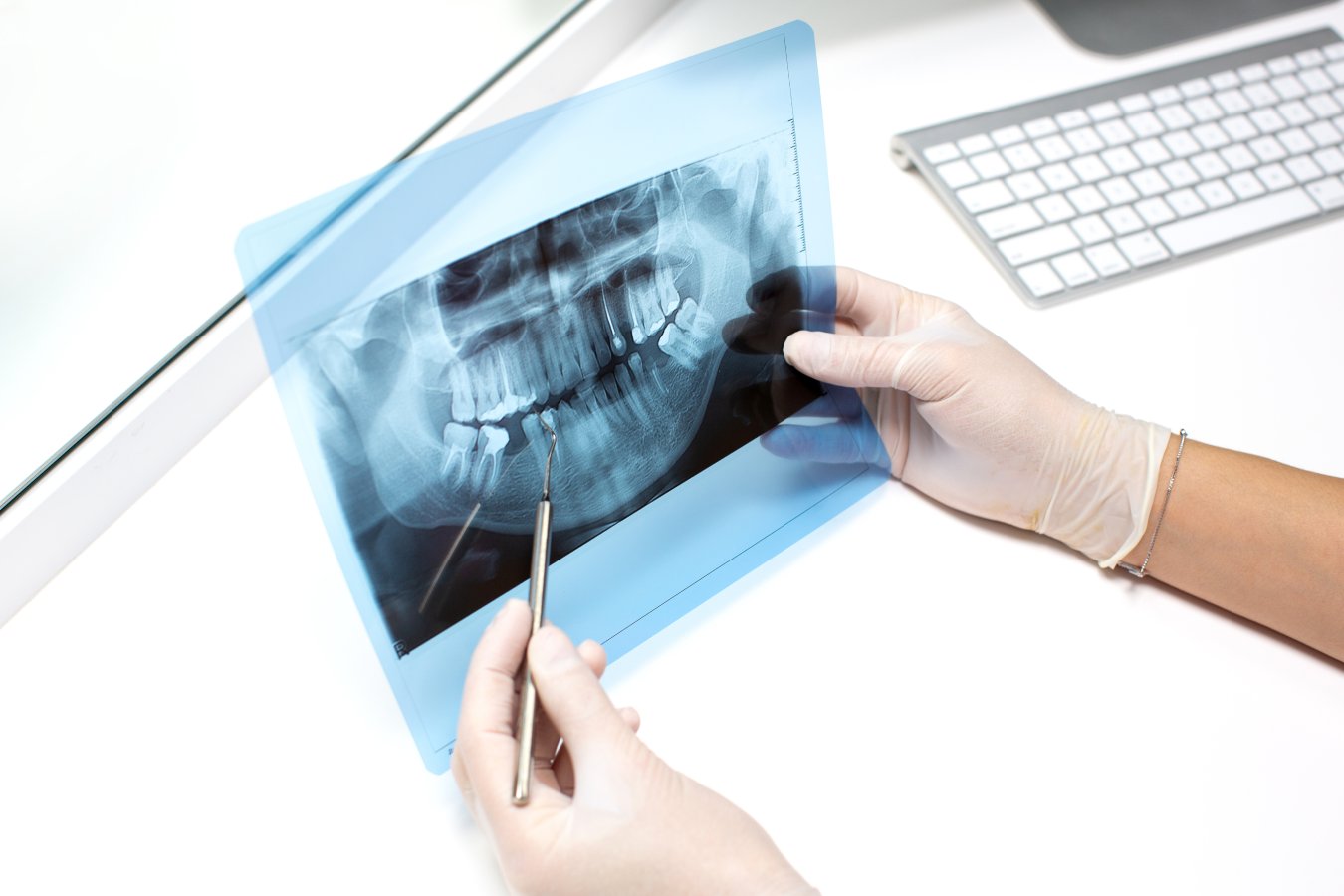
Ridge augmentation is a bone grafting procedure that rebuilds the jaw ridge — the horseshoe of bone that once held your teeth — when it has become too narrow or too short to hold a dental implant. It is done before or alongside implant placement, using either granular graft material held under a barrier membrane or a solid block of bone fixed to the deficient site. Most cases require a healing period of several months before the implant goes in, though smaller corrections can sometimes be grafted and implanted in one surgery.
Patients often hear “bone graft” as a single procedure and assume there is one operation with one recovery. There is not. Ridge augmentation, sinus lifts, and socket preservation are three different jobs on three different parts of the anatomy, and knowing which one you have been quoted for changes what you should expect.
How Ridge Augmentation Differs From a Sinus Lift and Socket Preservation
All three are forms of advanced bone grafting, but they address different problems:
- Socket preservation — Performed at the moment of extraction, filling the empty socket to limit the collapse that would otherwise follow. It is preventive. You can only do it before the bone is lost.
- Sinus lift — Performed only in the upper back jaw, adding height by raising the sinus membrane and grafting beneath it. It solves a ceiling problem created by the sinus.
- Ridge augmentation — Performed anywhere in either jaw, rebuilding the crest of the ridge itself after bone has already been lost. It is corrective, and it works on the outer contour rather than on a cavity.
Put simply: socket preservation keeps the ridge. Ridge augmentation rebuilds it. A sinus lift works above it. Some treatment plans involve two of the three, and in the upper back jaw a sinus lift and a ridge augmentation are occasionally performed in the same surgical session.
Horizontal vs. Vertical: Which Dimension Is Missing?
This is the distinction that drives everything about difficulty, timeline, and cost. The two deficiencies are not variations of the same problem.
Horizontal Deficiency — The Ridge Is Too Narrow
After a tooth is removed, the thin outer plate of bone on the cheek side resorbs first, because it depended most directly on the tooth root for its blood supply and its stimulus. What remains is a ridge that may still be tall enough but has narrowed toward a knife edge. An implant placed in it would have threads exposed on the outer surface with no bone covering them.
Horizontal augmentation is the more common and more predictable of the two. The graft is placed against the outer surface of the existing ridge, contained under a membrane, and it builds outward. There is intact bone underneath and beside it supplying blood and cells, and gravity works with the surgeon rather than against them.
Vertical Deficiency — The Ridge Is Too Short
Vertical loss means the entire crest has receded downward in the upper jaw or upward in the lower. This happens after long-term tooth loss, after significant periodontal destruction, after trauma, and after a failed implant leaves a crater.
Building height is substantially harder. The graft sits on top of the ridge, meaning it is surrounded by soft tissue on most sides rather than by bone. Blood supply reaches it from one direction only. The overlying gum must be released enough to close over the new volume without tension, and that soft-tissue management is often the deciding factor in whether the graft succeeds. Vertical augmentation carries a higher rate of complications than horizontal work in every published series, and it takes longer to mature.
This is why a surgeon may quote two very different treatment plans for what a patient perceives as the same amount of missing bone. The direction matters more than the amount.
Block Graft or Particulate Graft With a Membrane?
Two technique families cover most ridge augmentation.
Guided bone regeneration uses particulate graft material — granules of donor, bovine, or synthetic mineral, frequently mixed with bone collected during the surgery — packed against the deficient ridge and covered with a barrier membrane. The membrane matters more than most patients realize. Gum tissue grows far faster than bone, and without a barrier it would fill the space before bone had a chance. The membrane holds soft tissue out while bone grows in. Resorbable collagen membranes are used for contained defects; reinforced or non-resorbable membranes, sometimes supported by titanium mesh or tenting screws, are used where the graft must resist collapse.
Block grafting uses a solid piece of bone — harvested from the back of the patient’s own lower jaw or supplied as a processed allograft block — shaped to the defect and fixed to the ridge with small titanium screws. It provides immediate structural rigidity, which is exactly what large three-dimensional defects need. The tradeoffs are a second surgical site when the block is autogenous, a longer procedure, and a separate visit later to remove the fixation screws when the implant is placed.
The choice depends on defect size and shape, whether the site needs rigid space maintenance, and how much soft tissue is available to close over the result. Larger reconstructions often combine both — a block for structure with particulate material filling the gaps around it.
How Long Before the Implant Can Be Placed?
Graft material has to be converted into living bone capable of holding an implant under load. That process cannot be rushed, and the timelines commonly cited in the literature reflect that:
- Minor horizontal correction — Sometimes grafted at the same visit as implant placement, with the implant integrating while the graft matures around it.
- Standard horizontal augmentation — Commonly four to six months before placement.
- Block grafts and vertical augmentation — Commonly six to nine months, occasionally longer for extensive reconstruction.
After the implant is placed, osseointegration adds several more months before the final restoration. A staged ridge augmentation case is therefore realistically a nine-to-eighteen-month arc from first surgery to final crown. A surgeon who gives you only the surgical dates without the waiting periods has not given you the whole plan.
Where the anatomy allows it, an alternative worth asking about is immediate implant placement with simultaneous grafting, which compresses the sequence considerably. It is not appropriate for every site, and the requirement is enough sound bone to hold the implant steady on the day of surgery.
What the First Two Weeks Feel Like
Recovery from ridge augmentation is dominated by swelling and by the need to protect the site, not by severe pain. A typical course looks like this:
- Days 1 to 3 — Swelling builds and peaks, usually visible in the cheek or lip near the surgical site. Bruising is common. Cold compresses in the first 24 hours, then warm compresses. Prescribed pain medication is generally needed for the first few days. A soft-food diet, nothing hot, no straws.
- Days 4 to 7 — Swelling recedes and comfort improves noticeably. Most desk-based work resumes in this window. Gentle rinsing as instructed; no brushing directly over the site.
- Week 2 — Sutures are removed or begin to dissolve. The gum closes. The area still feels firm and slightly numb in places, which is normal as sensory nerves recover.
Two instructions matter more than the rest. Do not wear a removable denture or partial over a fresh graft unless your surgeon has specifically relieved it and cleared you to — pressure on a healing graft is one of the most common causes of failure. And do not smoke, because nicotine constricts exactly the small vessels the graft depends on.
Call your surgeon if pain increases after the first week instead of decreasing, if swelling worsens after day four, if you develop a bad taste or discharge, or if you can feel a hard edge of membrane or graft material through the gum. Those are evaluable signs, not emergencies, and they are easier to manage early.
What Does Ridge Augmentation Cost?
Cost varies widely and depends on the size of the defect, the technique, and the materials. As general orientation, a modest particulate augmentation at a single site is typically discussed in the range of several hundred to roughly two thousand dollars, while block grafting or vertical augmentation across multiple sites commonly runs substantially higher — often into several thousand dollars — because of the surgical time, fixation hardware, membranes, and possible harvest site involved.
Your own estimate will depend on your scan. What is worth comparing is not the graft fee in isolation but the total treatment cost through the final restoration, since a cheaper graft that fails becomes the most expensive option available. Ask for a written plan that separates surgical, material, and restorative costs, and ask what happens financially if a second graft becomes necessary.
Why Vertical Augmentation Is a Different Level of Surgery
Among routine implant procedures, vertical ridge augmentation is widely regarded as one of the most technically demanding things done in the field. The reasons are structural rather than mysterious:
- Blood supply is limited — The graft has bone on one side only. Everything else is soft tissue.
- Space maintenance is against gravity — Material placed above the ridge wants to collapse, so it must be held mechanically by a block, mesh, tenting screws, or a rigid membrane.
- Soft-tissue closure is the bottleneck — The gum must stretch over more volume than it originally covered, without tension. Membrane exposure through a tense closure is the leading complication.
- Adjacent anatomy constrains it — The nerve canal in the lower jaw and the sinus above limit how the site can be approached.
Outcomes in this category correlate more strongly with surgical experience and case volume than with any product or technique choice. It is reasonable to ask a surgeon directly how often they perform vertical augmentation, what they do when a membrane becomes exposed, and to see how they plan the case in three dimensions before you agree to it. For patients whose reconstruction spans an entire arch, this planning becomes part of a broader full mouth reconstruction sequence rather than an isolated graft.
Complex augmentation cases at our Hallandale Beach implant practice are planned from CBCT data with guided surgical protocols, so the graft volume and the eventual implant position are designed together rather than in sequence.
Frequently Asked Questions
Is ridge augmentation the same thing as a bone graft?
Ridge augmentation is a type of bone graft — specifically, one that rebuilds the crest of the jaw where a tooth used to be. Other bone grafts do different jobs, such as filling a socket at extraction or adding height beneath the sinus. When a treatment plan says “bone graft,” it is worth asking which procedure is meant, because the recovery and timeline differ considerably.
Can ridge augmentation and implant placement be done at the same time?
Sometimes. If enough sound bone remains to hold the implant firmly on the day of surgery, a modest graft can be placed around it in the same procedure. Where the deficiency is larger, or where the implant could not be positioned correctly in the existing bone, staging the two gives a far more predictable outcome. The scan determines which applies.
How do I know if my ridge augmentation worked?
Your surgeon confirms it with a follow-up CBCT scan that measures the new bone volume, and with direct assessment when the site is reopened for implant placement. Some resorption of the grafted volume is expected and planned for — surgeons routinely over-build slightly for that reason. Losing part of the graft is not the same as the graft failing.
What happens if I skip the graft and just get a smaller implant?
Occasionally that is a legitimate plan, particularly where a narrow-diameter or shorter implant can be positioned in sound bone. More often, forcing an implant into an inadequate ridge leaves threads uncovered, compromises the gum contour, and creates a restoration that is harder to clean and more prone to problems later. It is a discussion to have with your surgeon rather than a shortcut to assume.
Find Out Which Dimension You Are Actually Missing
Whether your ridge needs width, height, or neither is a measurement, and it takes a 3D scan to make it. A consultation that includes CBCT imaging and a plain explanation of the plan is the right first step. You can schedule a complimentary implant consultation to have your ridge evaluated.
Center for Dental Implants welcomes patients from across South Florida, with offices in Aventura, Hallandale Beach, and Pembroke Pines.